July 25, 2025
Why intention matters more than technique in watercolor
In watercolor, what's usually missing isn't technique, it's intention. A watercolor isn't built through techniques. It's built through an intention, and technique only comes in afterwards. To see this clearly, I use what I call the 3 Cs of intention: get out of a confused intention, reveal your concealed intention, then paint around a conscious intention.
What are the 3 Cs of intention?
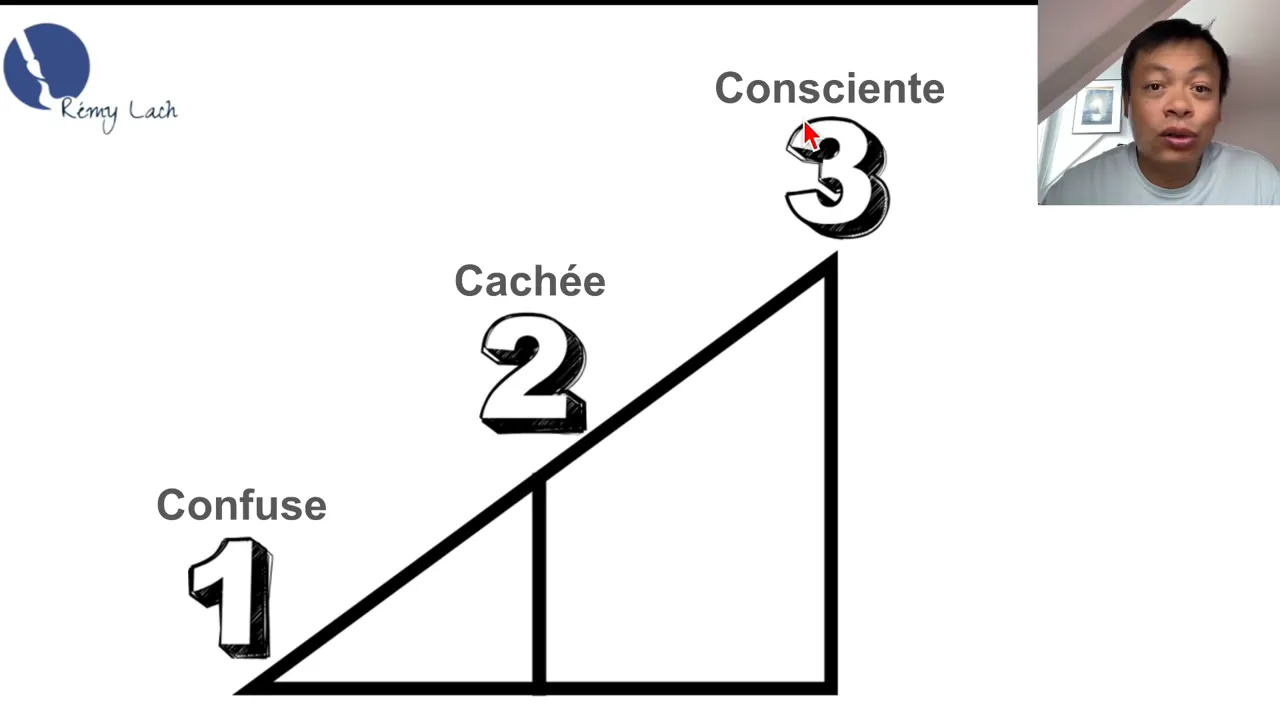
For years, I thought technique was what I was missing. The crucial element that actually helped me improve has nothing to do with technique. I picture it as a triangle with 3 levels. Each level matches one C, and also a level of awareness. That way you can place yourself: am I at awareness level 1, 2 or 3?
- The confused intention: you're aiming at the wrong intention.
- The concealed intention: you're not wrong, but you aren't aware of your intention.
- The conscious intention: you're clear on your intention and you build the watercolor around it.
There's also a level 0: no intention at all. I paint blindly, whatever comes to me. But in reality, there's always an intention behind it. If it isn't clear, there's going to be a problem, and the risk is that you miss the mark.
First C: how do you recognize a confused intention?
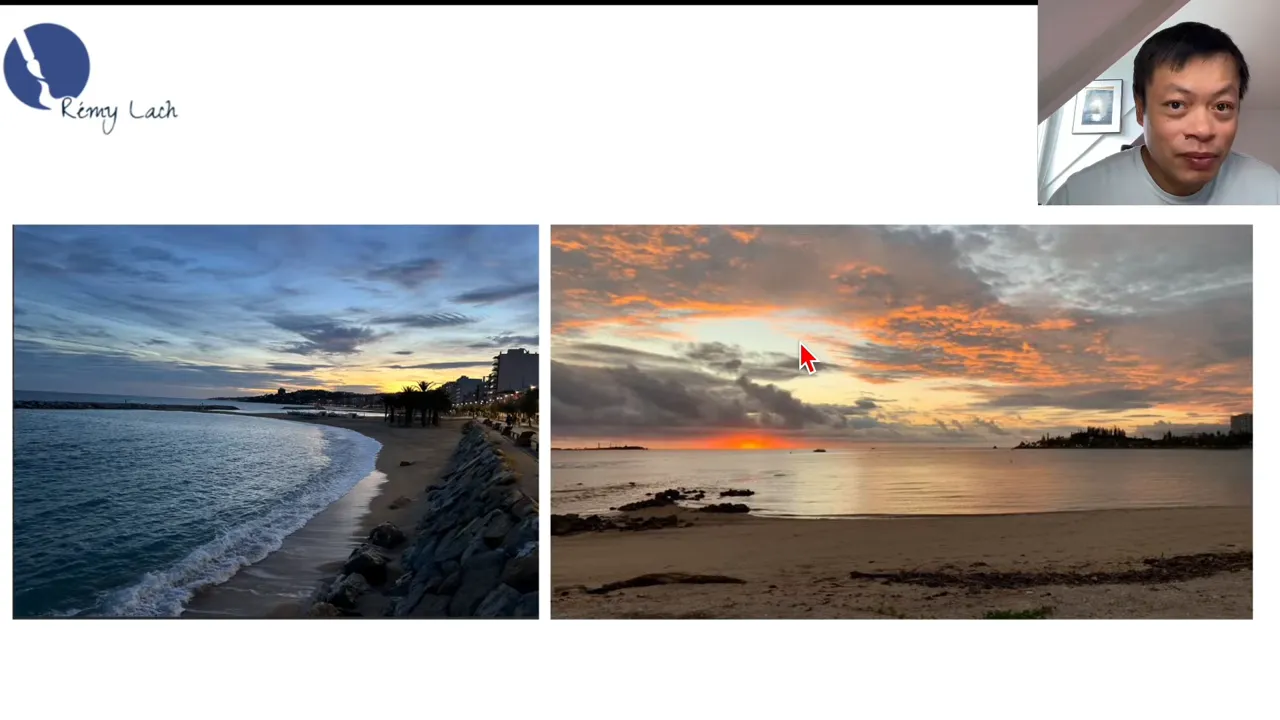
For a masterclass on beaches, I had asked my students to send me beach photos they wanted to paint. Looking at some of them, I thought there was a problem. First, they were really hard to paint. But above all, they were what I call false friends: you think you want to paint beaches, and in reality you're not painting beaches.
When I look at these photos, what moves me isn't the beach, it's the sky. And when I ask a student what they really wanted to paint in that subject, what often comes out is that the finished watercolor doesn't reflect the intention.
The question to ask yourself to get out of a confused intention: what is my intention, really? Maybe the photo is the right one, but the intention has to match the emotion you feel. Ask yourself:
- Do I just want to practice the technique? That can have nothing to do with the subject.
- Do I just want to take my mind off things?
- Does my intention match my emotion?
- Does the finished watercolor really match my initial intention?
Second C: how do you reveal your concealed intention?
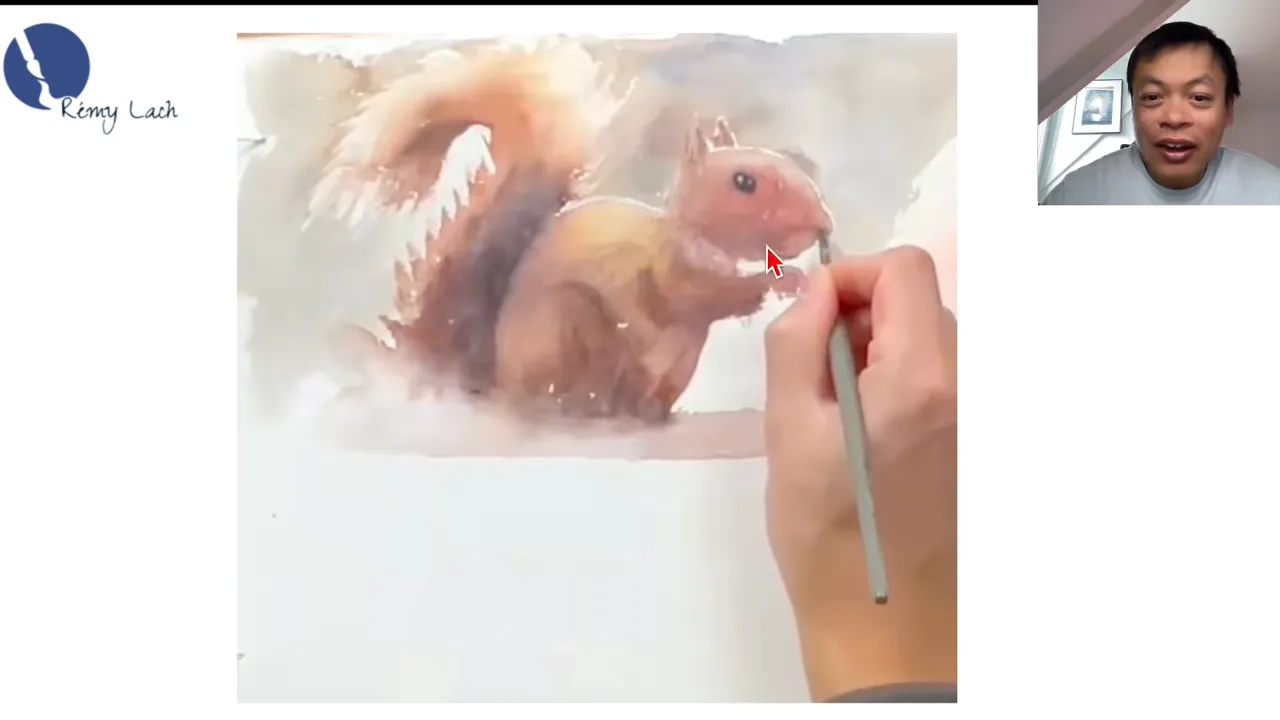
During live sessions with my students, people brought me subjects I hadn't mastered at all. A street scene with people, photographed while traveling. A squirrel, even though I don't think I can really draw and animals aren't my thing. A flower from a student's garden, even though flowers aren't my favorite subject.
Every time, beforehand, I hated the idea. And every time, I told myself: nothing to lose, let's go. While I was painting, I kept thinking: we could try it this way, we could try it that way.
- The street scene took me 10 to 15 minutes, mostly using the white of the paper and painting with a light touch, the way you would outdoors in a sketchbook. The student told me how much it freed her from the idea that you absolutely have to paint every detail.
- My squirrel's head looked more like a beaver, but the body came out pretty well. I was able to show negative painting techniques and how to render the coat, the fur and the tail.
- For the flower, people told me it really stood out and that I had managed to simplify it.
When you have subjects where you don't know where you're going, and yet 1, 2, 3 or 4 times out of 10 you end up with what I call watercolor treasures, moments where you truly enjoyed yourself, there's a concealed intention behind them.
To reveal it, you need to look back, only after the fact: what did I really love in those moments? What did I adore doing? What were the real realizations?
Steve Jobs, the founder of Apple, had an idea that resonated with me a lot: connecting the dots. You link things together, but afterwards. You can't connect them looking forward, only looking back. So the question to ask yourself is: what's the common thread? What links all those moments when you truly felt emotion?
For me, that thread is the moments of exploration with my students. Moments when I say: I don't know how to do this, but come on, let's try. I let go of the result completely, I stop being the one who knows and become the one who explores. That's when we've dug up watercolor treasures, and those are the best moments to let go. That's why I renamed these sessions "exploration live sessions".
Why do you really paint watercolor?
These 3 steps also apply to the deeper question: why you paint watercolor at all.
Often, the intention is confused: I want to exhibit, I want to sell my watercolors, I want people to tell me well done. When I started my YouTube channel, it was to sell my watercolors. That was a confused intention. After several years of teaching, I revealed my concealed intention: exploring watercolor treasures, discovering myself through watercolor, escaping, and above all sparking breakthroughs and realizations in my students. That's why I'm stopping selling my watercolors and sharing my realizations instead.
Once you've identified this intention, you're no longer bound by the rules you're told to follow: you have to sell, you have to exhibit. You know what touches you in watercolor, and you can turn that concealed intention into a conscious one.
Third C: how do you build a watercolor around a conscious intention?
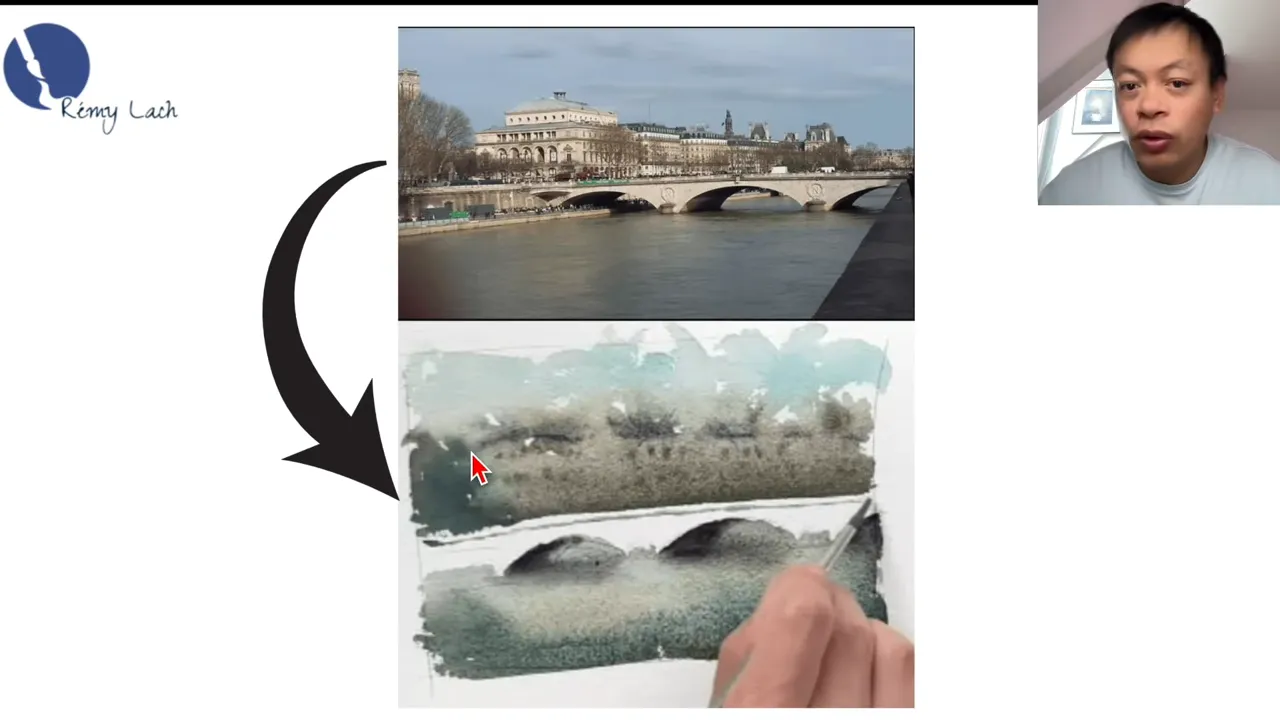
A student sent me a photo of a bridge in Paris, saying she didn't really know how to approach it. I told her: I don't know either, but what's your intention in this photo?
What touches me in this photo is the bridge. My conscious intention is the bridge, and I build the whole watercolor around it. But maybe her intention is the buildings, and then the watercolor would be completely different.
I painted it live in front of my students, in a few minutes, without knowing where it would take us. What mattered was staying true to my intention. The students found it magical. And yet, apart from the bridge, I barely followed the photo at all: not the trees, not the tower. Intention lets you break away from the photo. It doesn't work every time, but with a conscious intention, your chances of painting a watercolor that touches you are much higher.
At this third level, the question is no longer "what is my intention?" but "how do I bring it to life?". Only then do we talk about technique.
FAQ
Do you have to stay true to the reference photo in watercolor?
No. I'm not trying to create something super rigid that looks photorealistic next to the reference. What I teach is letting go and painting with a light touch.
Do the 3 Cs only apply to watercolor?
No, they apply to any area of your life: health, family, friends. Why one friend rather than another, why one sport appeals to you more than another: there's always a concealed intention behind it.
Is painting without intention a mistake?
For me, painting completely blindly is a big mistake. As soon as you convey a message, you have an intention, but it needs to be clear.
If you want to finally create on your own, with a proven system instead of copying tutorials, this is exactly what you'll find here 👇
Discover The Loose Watercolor System