November 13, 2026
Why do I watch so many watercolor courses but barely paint?
When you watch a lot of watercolor courses but barely paint, there is usually a fear hiding behind it, and until you identify that block, you won't be able to get back to painting. The best way I've found to get past it is to bring play into it: explore, ask yourself "what will happen if I try this?", until the fun becomes stronger than the fear of failing.
Why do we watch watercolor courses without daring to paint?
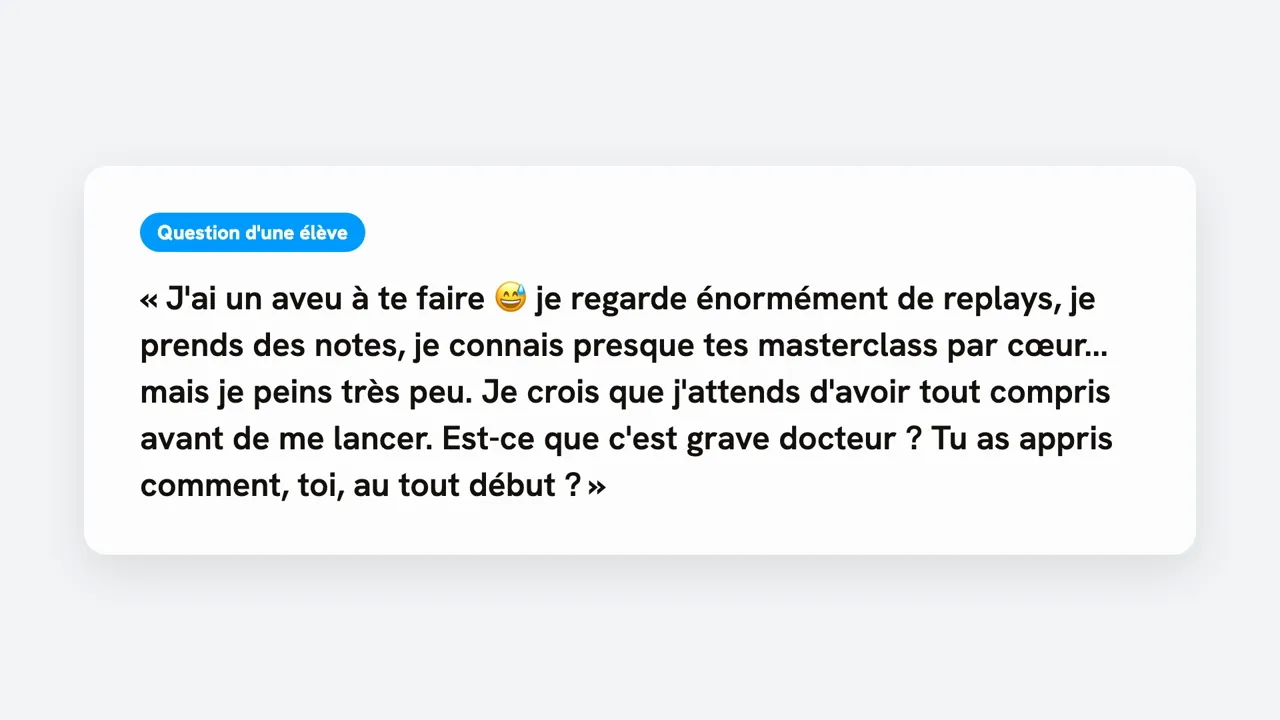
Someone wrote to me recently: "I watch tons of replays, I take notes, I almost know your masterclasses by heart, but I paint very little. I think I'm waiting until I understand before I start." That's not a big deal. But here is the real problem: in the end, you're painting very little.
When you paint very little, there is usually a fear. What's certain is that there's a block. It might be the fear of failing, or simply not being bothered to get started.
Watercolor has a sneaky side effect. When I was an employee, there was always a possible punishment: no raise, a warning, missed targets, getting chewed out in front of your coworkers. That forced you to do the job, even if your heart wasn't in it. With watercolor, there's no pressure. Nobody is going to come down on you if you don't do the job. Since nothing forces you to paint, it really is your natural state and your state of mind at that moment that decide whether you paint or not.
Do you need to understand everything before starting watercolor?
Wanting to understand everything is a good thing. But if you've already gone through the courses once and you have the big picture, you can then zoom in on a few concepts. The real block is somewhere else: something is holding you back, and you haven't yet found a way to move past it.
How did I learn watercolor at the very beginning?
I started with tutorials, copying other people. It's not the way I would recommend today. That doesn't mean it's necessarily a bad way, but for people who want to become independent in watercolor and paint their own paintings, I find it extremely hard.
It was fun, and my results were fairly satisfying, but I felt like nothing came from me. At some point, it became incredibly frustrating.
What got me to take action despite the fear of failing was the desire to make something unique, something other people didn't know how to do. As an employee, whether it was PowerPoint presentations, Excel spreadsheets or email reports, I felt like anyone else could do it. Meeting that need to feel unique mattered more than the fear of making a mess in watercolor.
Why does the fear of failing grow over time?
When you're a beginner, you have a kind of excuse: "I made a mess there, but I'm just starting, so it's fine." The problem is that as time goes by, that excuse stops working. You're no longer a beginner, and you're still producing things you find ugly.
Since that argument no longer holds, the only excuse left to replace it is: "I'm terrible at watercolor, I'm not cut out for watercolor." And that is awful, because it's the kind of thing that will paralyze you.
Why I can't paint watercolor anymore without playing
Today, the way I learn watercolor is really through experimenting. I can no longer learn outside of play. As soon as I stop having fun, I stop learning. That was an important realization: after a while, I couldn't even pretend anymore.
Playing means exploring, it means saying "Oh, what will happen if I do this?". That takes over the fear of failing, the fear of making something ugly, the embarrassment of showing you something that doesn't work, of looking like a fool, a clown, someone just messing around with watercolor. The joy I get from playing with watercolor and painting live with you is 10 times stronger than all of that.
On the other hand, as soon as I set myself a performance goal, I immediately feel the pressure, my hand tenses up, nothing works anymore, and I end up making a mess.
So my journey happened in 2 phases:
- The need to make something unique, to tell myself "I'm the only one who managed to do this", was stronger than "you're a beginner, there's no point".
- Playing with my students and discovering little watercolor treasures became stronger than the fear of producing something ugly in front of you that doesn't work.
How to find what makes you want to paint
The answer is different for everyone. Ask yourself this question: what got you to take action in watercolor in the past? What, at some point, made you really want to try something?
- Maybe it was a certain type of subject.
- Maybe it was a student's painting that made you want to try it too.
- Maybe it was something that really got you hooked.
Lots of things can give you that spark, and you need to find yours.
It's an ongoing quest. Every time you feel resistance to painting, it's actually great, because it means there's something you can change. If I keep reinventing myself and creating new things in my teaching, it's for me: otherwise I get bored, and I no longer want to paint or teach. It's quite possible that next month, I won't want to paint the way I paint today. For me, there is one constant: the impermanence of watercolor. The way you paint today won't be the same tomorrow or the day after.
Your job, so you don't fall into "I don't feel like it" or "I can't get myself to start", is to keep finding that little thing that makes you say: "I want to get started so badly that I don't care." I don't care if I don't have time. I don't care if it's ugly. I don't care if I'm ashamed of what I make. I don't care if I'm terrible at watercolor.
FAQ
Is it bad to watch watercolor courses without painting?
No, it's not a big deal. It's the sign of a block, often a fear, that you need to identify so you can get back to painting.
Should you keep learning watercolor with tutorials?
For me, tutorials are a good way in, but not a path to independence. If your goal is to paint your own watercolors, experimenting and playing will take you further.
Is it normal to no longer want to paint the way you used to?
Yes. Your watercolor practice keeps renewing itself, and resistance to painting simply shows that there's something to change.
If you want to finally create on your own, with a proven system instead of copying tutorials, this is exactly what you'll find here 👇
Discover The Loose Watercolor System