August 5, 2026
Why don't watercolor courses work for me?
A watercolor course rarely works when you try to copy and paste the teacher's whole system into your practice, because you already have your own system, your own story and your own skills. Find which part of your creative process is broken, then take from the course only the gear that resonates with you and put it into your own process. You don't have to replace everything: often, what's not working is just one gear.
Why do you feel blocked after a watercolor course?
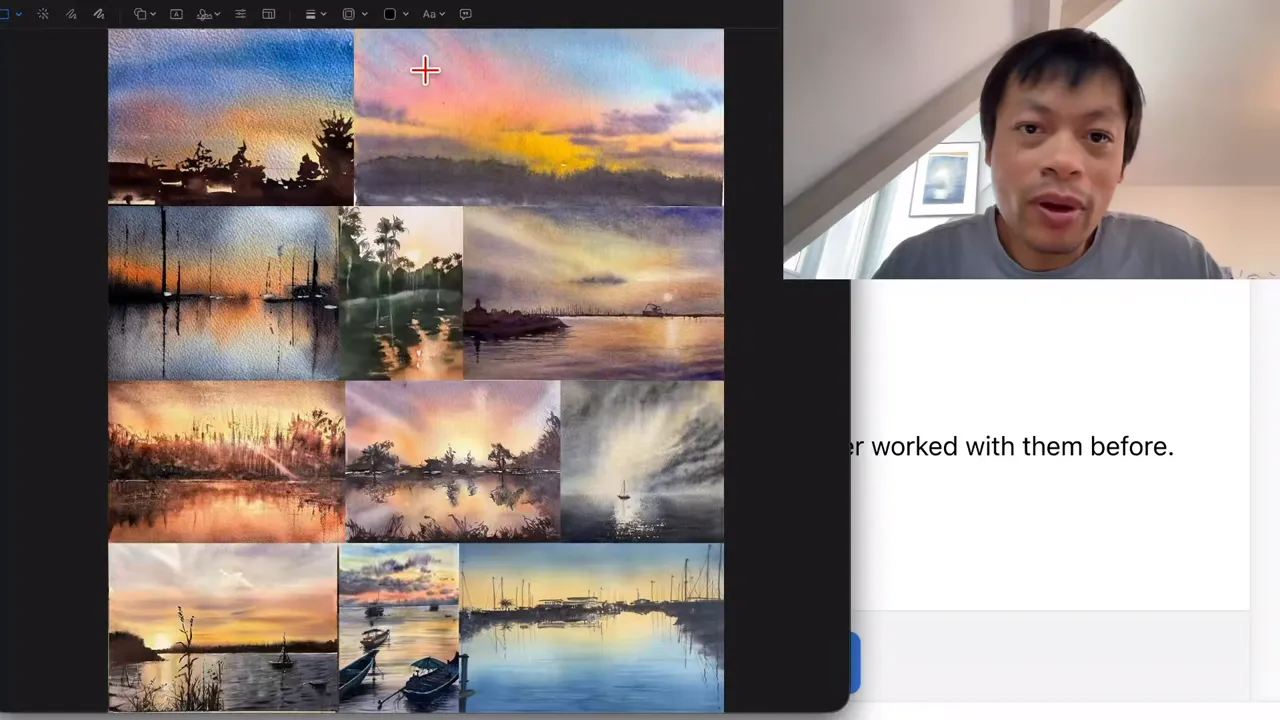
It started with a question from a student I coach: "I'm having trouble using the tables you suggested. I recognize they're interesting, but they're blocking me. What should I do? What question should I ask myself?"
This is the issue we all run into when we take a watercolor course. It may be an online course, a course in your town or a workshop with a famous artist. It can help you in the short term, because it gets you to take action and create something you can be proud of. But the real question is: what's really left after the workshop, after the course? What can you bring back to your own practice?
What does a proven watercolor method look like?
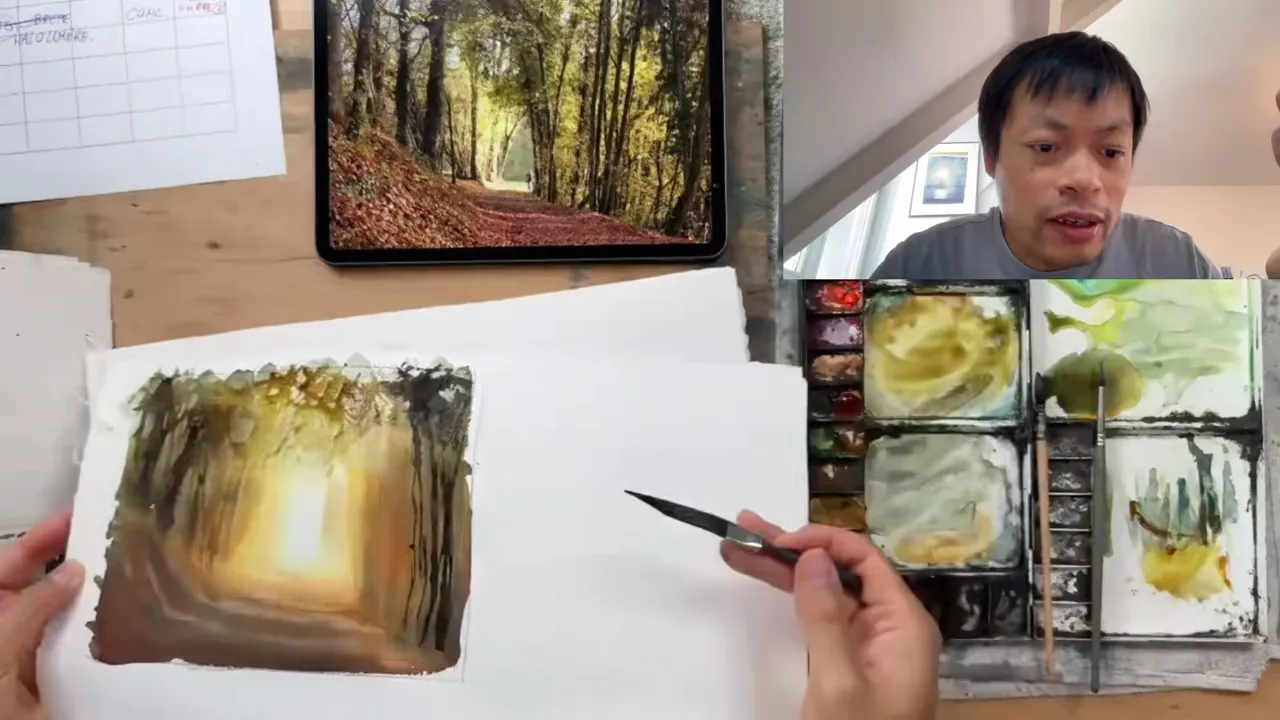
Here is how I work. Every week, all the members of my community work on the same reference photo from one of my students. After they have painted their own version, I paint it live in front of them, accepting that I may fail if it doesn't work.
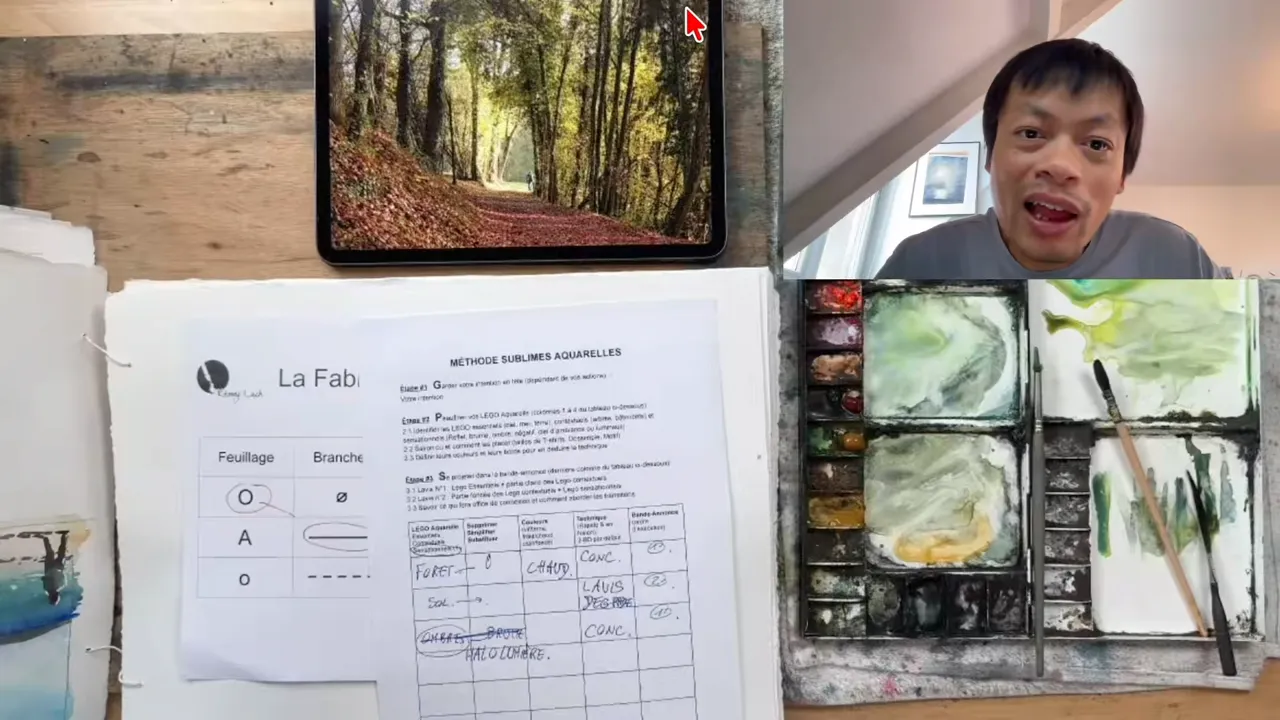
My system works like this:
- I make a table where I list all the elements of the photo: the trees, the floor, the person.
- For each element, I think about which painting techniques and drawing techniques I can use to convey it, to suggest it, without sticking too much to the photo.
- I translate every single element into a watercolor technique.
- I execute them.
My students see it work live during the session. But I understand that having to plan your painting and list all the elements first can break the flow. That is exactly what happened to me with a YouTube course.
What I learned from 2 YouTube courses
I have never taken a watercolor course in my life. But I struggle with making YouTube videos, because I'm not at ease with English, I have a terrible accent, and I don't know if I'm understandable. That blocks me a lot. So I signed up for an online course on how to make YouTube videos and launch your channel.
The teacher's methodology was interesting, but it didn't resonate with me. I had to plan my video, list all the topics, create all the titles, create the thumbnails. There was so much data, so much information, that in the end I didn't take action. I rejected his methodology, even though I admitted it worked.
After 1 month, then 2 months, I still hadn't published a single video. So I took a second course with another methodology, and again I found reasons why it didn't work for me. I could find any reason in the world to justify my procrastination.
The switch happened the day I thought about buying a third course, looking for a holy grail of YouTube that would give me all the answers so I could copy and paste a proven system. Before doing it, I asked myself: maybe the first 2 courses have something to teach you?
That question changed everything. If you still find someone else's methodology interesting, it means some part of it rings a bell. Which part is it exactly?
Which part of your creative process is broken?
If you struggle with watercolor, something is broken in your creative process. You need to know which part:
- Is it choosing a topic?
- Is it planning your watercolor painting?
- Is it the drawing?
- Is it executing the painting?
- Is it how you see the outcome?
Each of these little elements can break, and if one breaks, the whole process stops working. You end up doing nothing, or doing something ugly. So find the broken part, and ask yourself whether you can take the gear that works for another person, steal it, and copy it into your own process.
This way you stop the binary thinking where a course either "doesn't work" or "works like a charm." The answer is not right or wrong, it's in between. You don't replace your whole creative process, only a few parts of it, or sometimes just a piece of one brick.
If you get rid of all your machinery, you will jump from one methodology to another, from one tutorial to another, collect contradictory information and get lost in everything that is available online.
How to take what resonates from a watercolor course
My methodology has 3 big pillars:
- Watercolor painting techniques, and how to create marvels in minutes, not hours.
- How to grasp the soul and the essence of a topic in minutes, without sticking too much to the details.
- Once you master the first 2, how to create your own paintings from your own photos, without any tutorials.
I told my student she doesn't have to copy it all. Take what resonates. Within the first pillar there may be 10 painting techniques or 5 drawing techniques: which one speaks most to you? In the second pillar there are topics like skies, fog or mountains: which theme resonates with you, and which techniques inside it?
From my YouTube courses, one piece of advice rang a bell: instead of giving basic advice, talk about the problem, share an example, then share the lesson. That's what I'm doing here.
Try it with the last course you took, whether it was a workshop, a retreat, an online course or a YouTube video. Maybe 99% of it doesn't work for you. But maybe at one point you thought, "Oh, this is interesting, this changes how I see watercolor, I want to try this technique." Taking just that part makes the course 10 times more useful than throwing away a course you already paid for.
Why you don't need to feel guilty about your own process
My own process is different. I don't like painting from my own photos. I used to struggle to interpret them and it didn't work. So I paint from my students' photos instead. It's so much easier for me, maybe it's an ego thing, and it helps my students a lot more.
I don't feel guilty anymore, because my creative process is not broken, it's just different, and there's nothing wrong with that. When you look at your practice this way, you stop feeling guilty about how you work, and you improve your creative process incrementally without questioning everything you've learned so far.
FAQ
Should I buy another watercolor course if the last one didn't work?
Not right away. Go back to the courses you already took and look for the one idea that caught your attention. Searching for a perfect system to copy is what kept me from publishing anything for months.
Do I have to follow a teacher's method exactly?
No. Even with my own methodology, I tell my students they don't have to copy it. A teacher's system is one point of view, and yours is already working in many places.
Is it wrong to work differently from your watercolor teacher?
No. I paint from my students' photos rather than my own because it works better for me. A different process is not a broken process.
If you want to finally create on your own, with a proven system instead of copying tutorials, this is exactly what you'll find here 👇
Discover The Loose Watercolor System