November 27, 2026
What to leave out of a reference photo when painting watercolor
To decide what to leave out of a reference photo before painting it in watercolor, I always ask myself the same question: what matters to me in this subject? Then I look at each element in the photo and ask whether it contributes to what matters. If the answer is no, you probably don't need to keep it.
What questions should you ask in front of the photo?
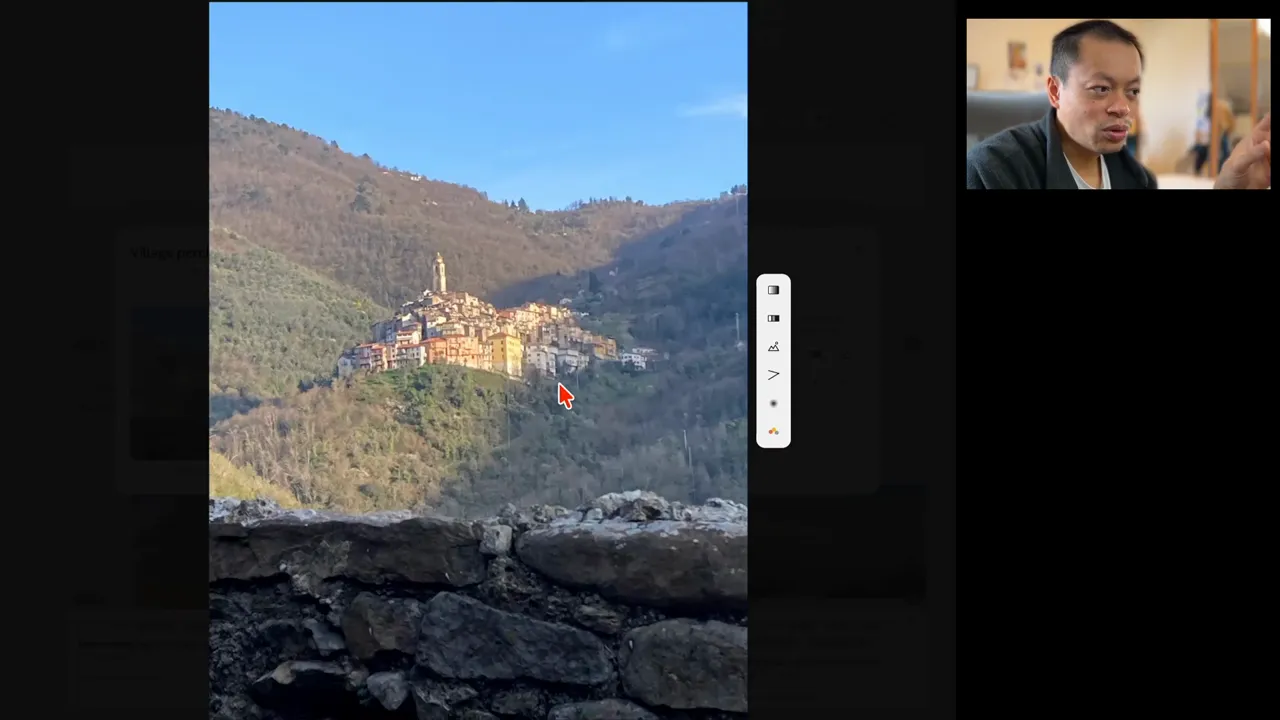
Take this photo of an Italian village that one of my students shared. My first instinct would be to get rid of the low wall; I'm not sure it adds that much. But what does "doesn't add that much" actually mean? Not many things create a real impact in a watercolor.
The thought process comes down to 2 questions:
- What matters to me in this subject? Be careful: if the wall mattered to you when you took the photo, then that's exactly what you shouldn't remove. Here, what jumps out at me is the village bathed in light.
- Does everything I see contribute to what matters? The wall does have some value: it gives a kind of foreground and adds depth. But does it bring light into the village? Not really. That's why it doesn't feel especially necessary to me. Same thing for the sunlit hillside: does it bring light onto the village?
In another photo, what counts for me is the sunset. Does the sea add anything? I'm not sure; you could almost remove it. The vegetation, I'm not convinced either. On the other hand, the very dark background may well add something, because it creates depth against the sunset.
Can you replace or exaggerate an element instead of removing it?
Yes, and that's where you break away from the photo. With the sunset, I thought: if there were a road leading toward the sun, it would be worth keeping. So why not replace the sea with a road? At that point, you're no longer copying; you're creating something that serves the main message you want to send.
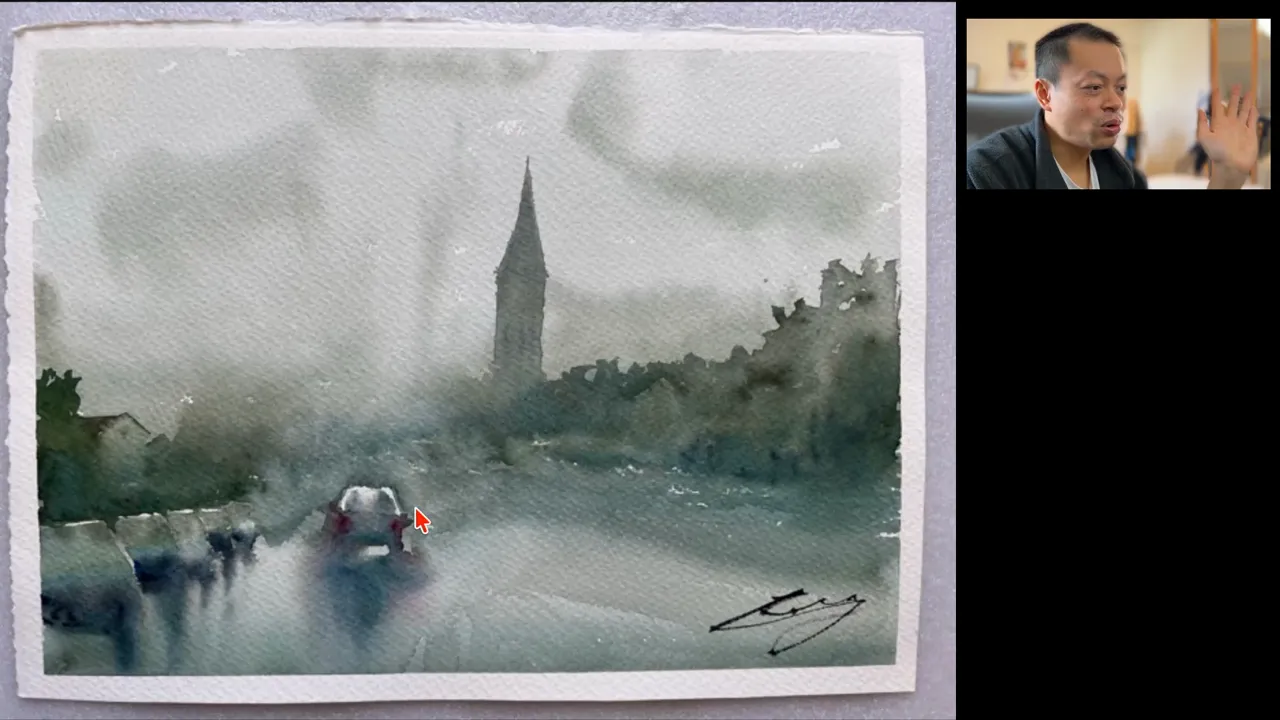
I'd already done this when I was starting out, back in 2016, with a photo taken near my home at the end of the day. What mattered to me was the bell tower. The evening light didn't really catch my eye: what I wanted was a rainy mood. There weren't many details in the shaded part, and that's exactly what I painted.
If there are things you can remove, there are also things you can exaggerate, pushing them to the limit to see if the painting still holds. I brought the bell tower forward. The perspective isn't consistent at all, but that doesn't matter. I kept one house because I wanted it to read as a town, with houses and a car, and that's it. And the watercolor holds up.
Someone once told me, "It's amazing how many liberties you take." A subject is yours to do whatever you want with. There are no rules; you set your own. The one that has proven itself for me is: what matters to you, and how do you make your watercolor serve it?
Why do we cling to details we should leave out?
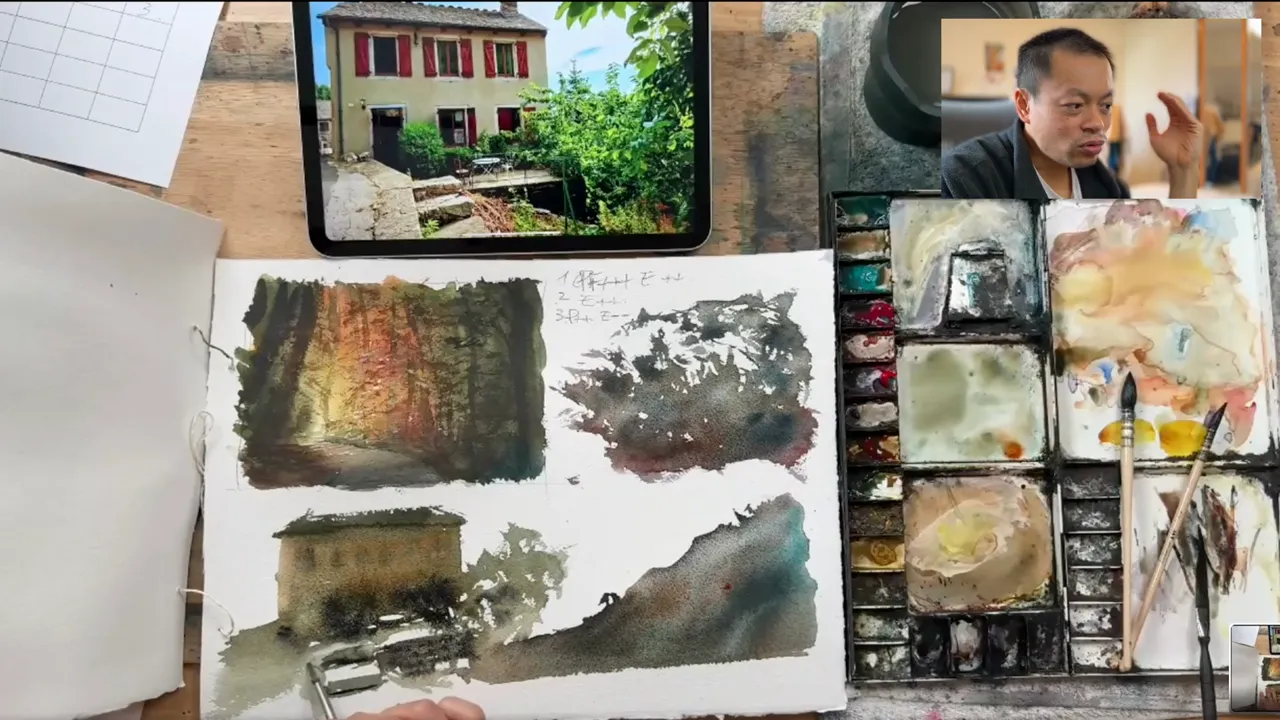
A student asked me how I would paint a terrace. There wasn't much light, and the subject didn't seem easy to me. I focused on the terrace, where you can see the light. I painted the building in the background while leaving the terrace in the light, with the steps, the table, the chairs, the little wall and the vegetation on the right. Everything else isn't that important. The steps were drawing a bit too much attention, so I glazed over them to darken them a little, and that gave that area its importance back.
This student wanted to keep everything, because it was all part of the charm of the place. That's a trap when you paint subjects that move you, like a friend's house, or a portrait of someone close to you. You'll see elements that matter to you but that, paradoxically, will work against your watercolor, often because they're too complicated to paint.
If you say "the green shutters are really important to me," you're going to struggle with the technical execution. Light in foliage, for example, is hard to render well: you may need masking fluid, a first wash that's really vivid, then a second pass with the shadows around the leaves. Just thinking about it doesn't excite me. Unless that's really what I want to paint: then I remove everything else and do a study of the foliage alone.
There's a balance to find between what matters to you and what matters for your peace of mind and your technical execution. When emotions are involved, you make decisions that serve neither your execution nor your watercolor, you stick to every detail you can, and the result isn't great at all.
Can you leave out too much from a photo?
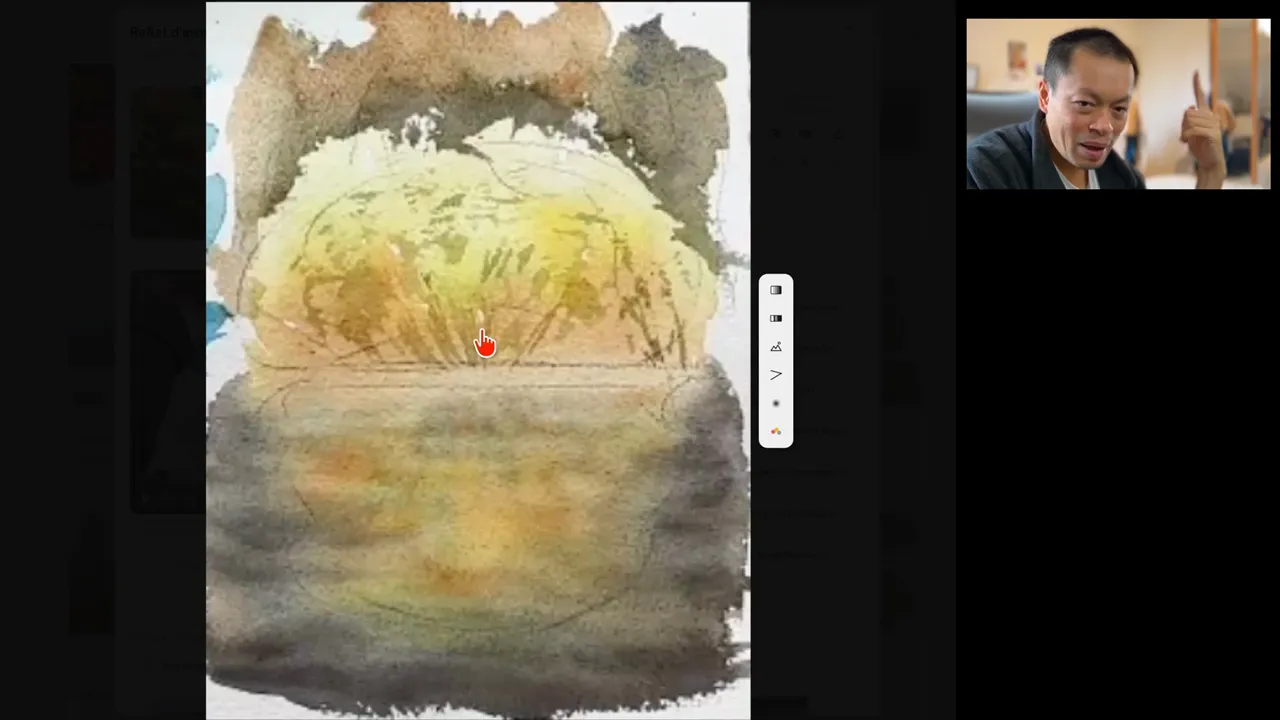
Possibly, yes. On one subject, I removed everything around it to reduce it to its simplest form. I find the result ugly, and above all I didn't enjoy painting it. I think the two are linked: when it turns ugly, you lose the joy of painting. I told myself I should have kept the whole subject and figured it out.
Right after that, I took on a complete subject, and the result was really nice. Here's what I take away for my own practice:
- If you know you're going to struggle with a subject, simplify it and remove 2 or 3 things.
- If you have no idea how to tackle it and you're curious to see how you'll manage, paint the whole subject and figure it out. Along the way, you'll discover things you'd never have imagined.
This may have to do with the way I approach a new subject, and for you it might be the opposite. But if you catch yourself thinking "I wish I'd painted it all, it would have given me more freedom," you left out too much.
How should you think after a failed watercolor?
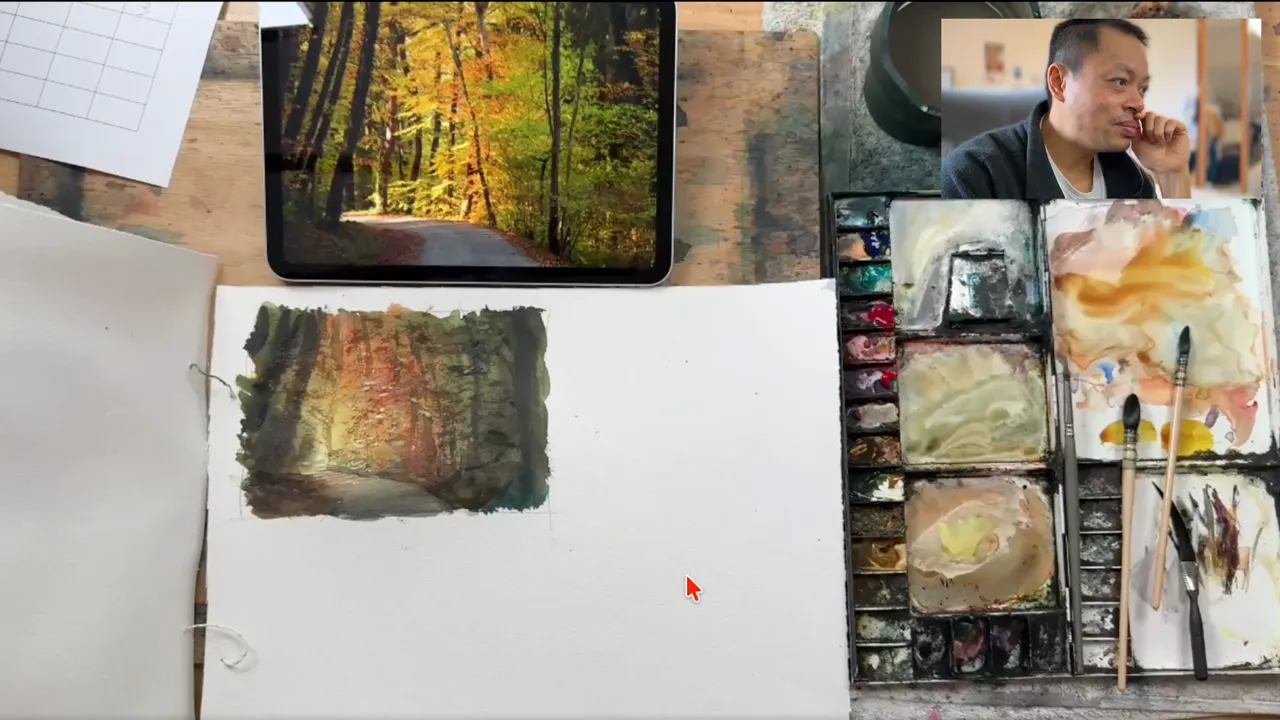
I felt terrible about a recent watercolor. I was happy with the first wash. In the second wash, a glaze created an interesting contrast between shadow and light. Then I added the tree trunks: they stood out too much. I added some foliage without much conviction, then white watercolor to bring back the light in the leaves, and a swipe of my finger smeared the white. In the end, I lost the light.
Looking back, I wonder whether I should have skipped the second wash altogether, or the shadows, and stopped at the little path with the trunks dropped in wet-in-wet. If I had to paint it again today, I'd push the first wash much further instead of leaving it as it was. This is no longer about what to remove before painting, but about how to think afterward when you're not happy with the result.
Capturing the soul of the subject, or what matters to you?
"How do you capture the soul of a subject?" is an almost binary question: there's a right answer and a wrong one. I find it more useful to ask: what do I need to do to convey what matters to me? It's personal, and there are lots of ways to approach it: colors, techniques, drawing. That opens up a much wider world of possibilities.
The question "what matters to me?" changes the way you paint, what you select, and the experience you have. If you take on a subject that's really hard for you, with negative painting, lots of details and heavy texture, the experience can be so disastrous that it makes you want to give up. This question helps you focus on what's essential.
FAQ
Should you always remove the foreground from a photo?
No. It all depends on what matters to you: an element that struck you when you took the photo is worth keeping, and a foreground can also add depth.
Why is it hard to simplify a subject that moves you?
Emotional attachment pushes you to keep everything, including details that are too complicated to paint. You end up sticking to the subject instead of serving your watercolor.
How do I know if I've left out too much?
The signal is a lack of enjoyment while painting, and regretting that you didn't try the whole subject.
If you want to finally create on your own, with a proven system instead of copying tutorials, this is exactly what you'll find here 👇
Discover The Loose Watercolor System