November 20, 2026
How can other painters help you loosen up in watercolor?
To loosen up in watercolor, the best way I know is to spend time around people who are letting go themselves. When you watch them do it, and see the beautiful things that come out of it, you naturally want to try it too, without having to keep telling yourself "I need to loosen up."
Where does this idea come from?
It hit me during the very first live session with the students of a new coaching program I run in French. The session was about a purple forest: a violet landscape with a figure and trees on the left and right. At first, I followed my usual structure. I explained how to create light in the sky, on the ground and in the foliage, then I pointed out what I felt the students could improve, especially the light that sometimes got lost in the sky.
At some point, questions started coming in that went beyond the structure I had planned. That's when the session became exceptional.
How do you keep white spots when you rewet a wash?
One student asked me this: in my step by step, I manage to leave little white spots, but I also ask you to rewet the wash. How do you go back into the wash without wiping out the white areas? When she tries, she spills over the edges and it doesn't work.
My answer was the dot: you add water here and there, sparingly. That way you rewet the wash without flooding every area.
To show it, I was painting trees. Then I noticed they looked like the roof of a house, so I added a little chimney. Since I had made some marks, they reminded me of vineyards. By the end of my explanation, there was a little village with rows of vines receding into the distance. It was a tiny demonstration, just a few seconds long, and to me it's the most beautiful thing on the whole sheet.
That's what I call the treasures of watercolor. In a structured course, whether online or in a workshop, where you follow a set structure you can't stray from, there's no way they could ever come out.
What is overworking in watercolor?
After that, a flood of questions came in. One of them was about overworking: does overworking mean going over the same area several times? That's what I used to say. But in the moment, I wondered whether that was really it. I searched through all my past experience to explain it in a new way, and a diagram came out of it.
Overworking isn't only about going over the same areas. Several factors play a part. The ones that came to mind at the time were these 4:
- going over the same areas;
- the pressure on the paper;
- the speed of your stroke;
- how wet the paper is.
There may be others. For each one, I showed what to do, what not to do, and why you overwork when you do what you shouldn't.
Instead of a vague, abstract concept, the student can tell herself: when I overwork, it's probably because of one of these 4 points. Once you become aware of it, for example "it's the pressure I put on the paper that makes me overwork," your diagnosis gets precise enough to trace the problem back to its root cause and change the way you paint.
That diagram could never have been created if I had sat down in front of a blank sheet wondering how to make a lesson on overworking. It came out spontaneously, during the live session.
Why does watching someone let go help you let go?
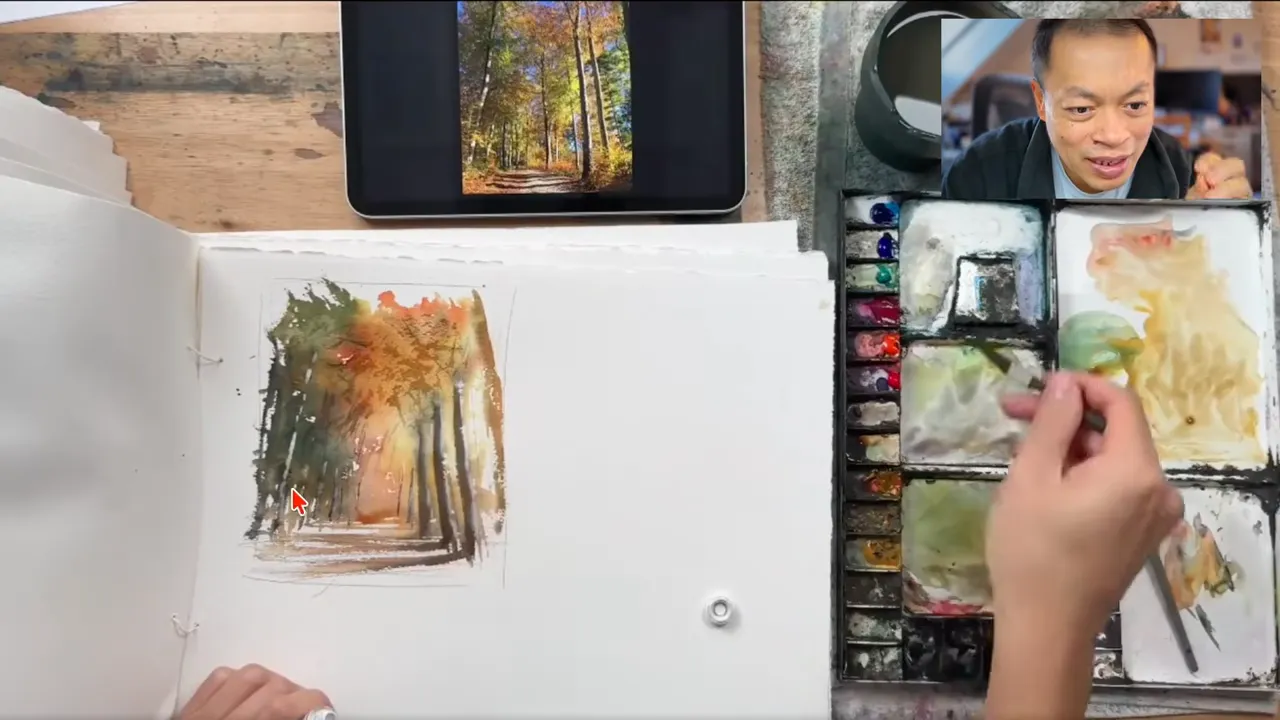
During that session, I let go of the idea that it had to be perfect and unfold a certain way. I told myself: let life's intelligence come through and let it show you the treasures of watercolor. Because I had no fixed expectation, I gave myself the chance to think of something else, and new things were created.
The students felt it. Asking a question means taking a risk: the risk of looking stupid. But when one student dared to ask, and something beautiful came out of it, the others thought: "I can ask my question too." Then more questions came, again and again. Nobody had to force themselves. All it took was watching something happen that no one expected.
It's the same on the program's forum. When students dare to post something that may not look great in their own eyes, the others think maybe they can do it too. Little by little, and very naturally, you let go of the expectation that it has to be beautiful, that it has to go a certain way, or the worry that you didn't do it exactly as you were supposed to.
Why is it so hard to loosen up?
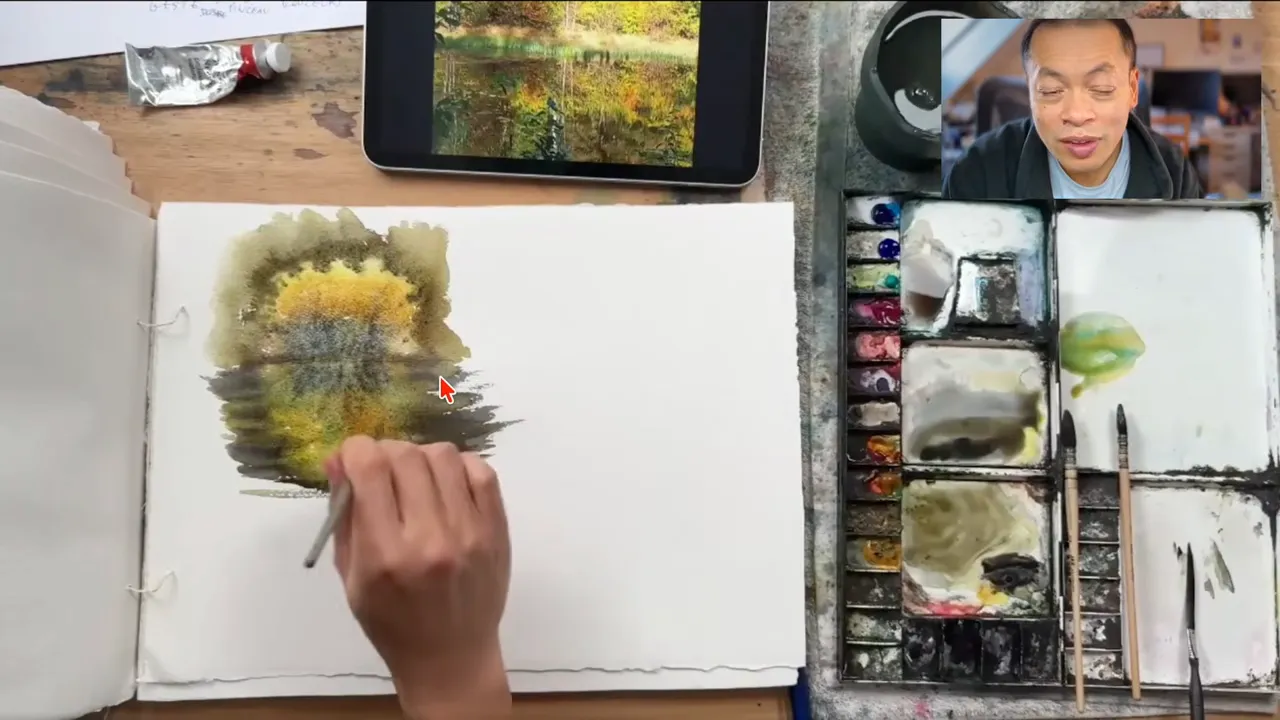
What keeps you from loosening up in watercolor today is a preconceived idea: if I let go, something bad will happen. Or an expectation: it has to go this way.
Take a romantic relationship. If you're jealous, possessive, with an absolute need for reassurance, and you're surrounded by couples who have let go of needing to be loved, you'll see magical, unexpected, unpredictable things come out of those relationships. These counterexamples can make you want to try something different. You can even ask those people questions.
In every area of your life, whether it's money, love or art, surround yourself with people who dare to let go. They act as a mirror, and it will rub off on you.
FAQ
Should you force yourself to loosen up in watercolor?
No. Telling yourself over and over that you need to let go doesn't work. What helps is watching someone who dares, and seeing something beautiful come out of it.
Why does daring to ask a question help you loosen up?
Because it means accepting the risk of looking stupid. A question that seems ordinary or too basic can bring out something unexpected, and inspire others to dare in turn.
Does a very structured course help you loosen up?
Not really. When you follow a structure you're not allowed to stray from, the treasures of watercolor, those beautiful spontaneous surprises, can't appear.
If you want to finally create on your own, with a proven system instead of copying tutorials, this is exactly what you'll find here 👇
Discover The Loose Watercolor System