March 24, 2025
How to repaint a failed watercolor to make it better
To repaint a failed watercolor and make it better, make one single aspect your absolute priority, the light for example, even if everything else ends up looking like nothing at all. That priority forces you to simplify everything else, which becomes secondary. And don't throw away the first version: it also holds things that worked and are worth keeping.
Why did my first watercolor fail?
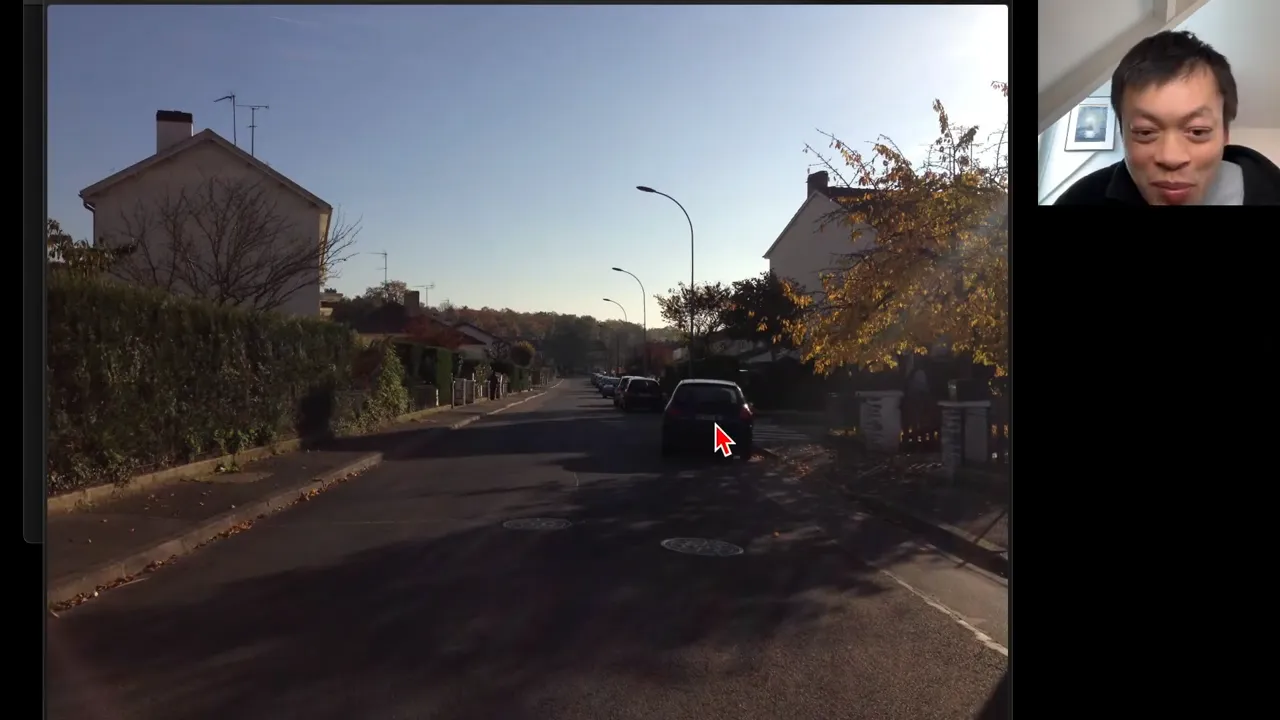
I started from a photo I took during lockdown, in a street right next to my home. Looking back, I find it fairly difficult, and I'm not even sure I would choose it today.
On a sheet of about 30 by 40 cm, which usually takes me between half an hour and 1 hour, I spent forever. I wanted everything to be right:
- a nuanced sky, with beautiful colors;
- houses that kept that end-of-the-day feeling;
- the shadows I had seen in the street, with almost rainbow-like effects, as if the light had split apart to let through a slightly green part and a slightly purple part.
I tried so hard to stick to the photo that in the end, I didn't like the result at all. Above all, I had lost the twilight glow that was in the photo.
How can frustration help you repaint a watercolor?
Usually, I like to let a watercolor sit for about a night, 24 hours. The next day, I put it a little further away from me, look at it, and tell myself it's not that ugly after all. This time, I didn't even ask myself the question. I was furious. Within 5 minutes, I had taped down a new sheet and was already painting the sky.
A rational part of me was saying: "Stop, you only have half an hour, you just spent 1 hour, it's impossible." I did it anyway, in about 20 minutes. The result was far more convincing, far more airy, far lighter.
For me, this is the prerequisite of the method: anger and frustration are things we want to avoid, but sometimes they are extremely powerful drivers. Sometimes they can be very destructive, and sometimes they can be so much more powerful than inspiration. I'm not saying inspiration is bad, but frustration, and anger even more, can be a great driver in your watercolor practice.
How do you choose a priority in your watercolor?
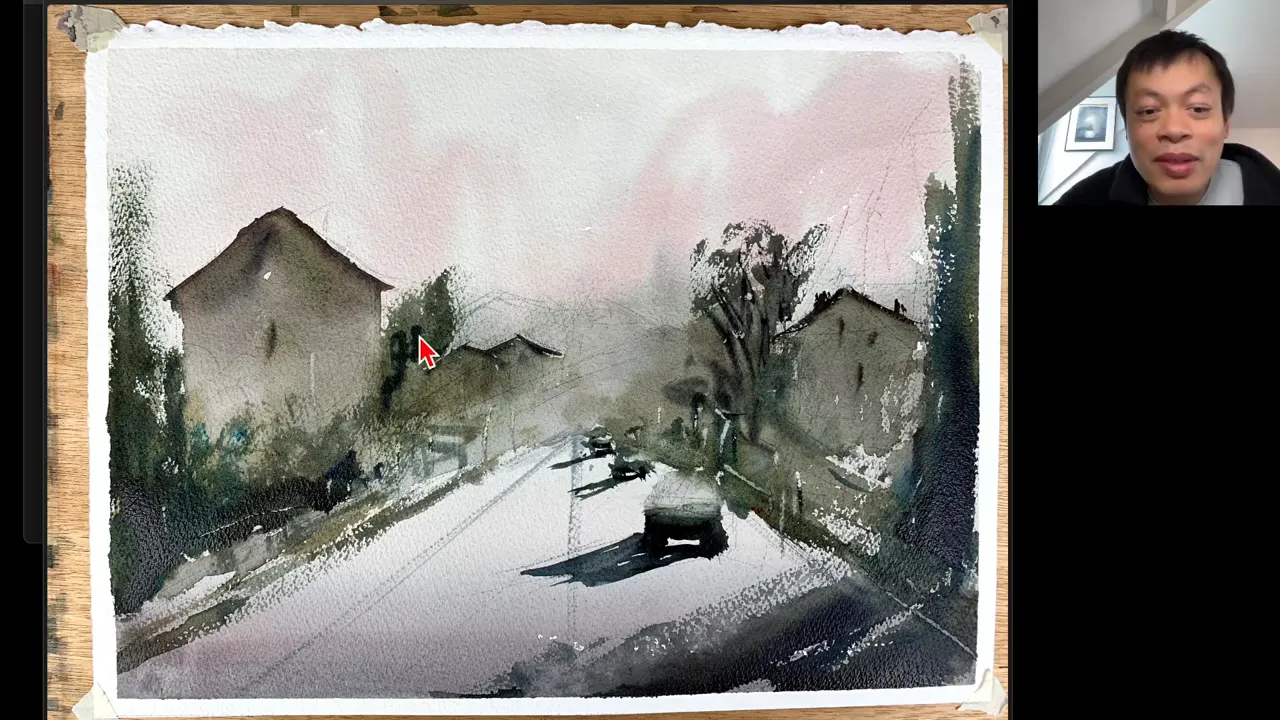
Make your intention a priority. Mine was: I lost the light. That was so unthinkable to me that I made capturing that light the absolute priority of this watercolor. In practice:
- I pushed the contrast.
- I put 10 times more pigment in the shadow than in the first watercolor.
- For everything else, I didn't care: I used the gray left over on my palette.
The result has very little consistency. The sky is glowing red, the road is borderline purple, the houses are green and a bit too tall, the perspective could be better, and you sometimes wonder whether the texture of the trees really looks like trees. I painted the houses in 2 dimensions, whereas in the first one I had tried to paint them in 3 dimensions. And yet, to me, this watercolor works despite all these flaws.
Making one aspect of your watercolor a priority forces you to simplify everything else. Everything else becomes secondary.
Why does black-and-white thinking keep you from improving?
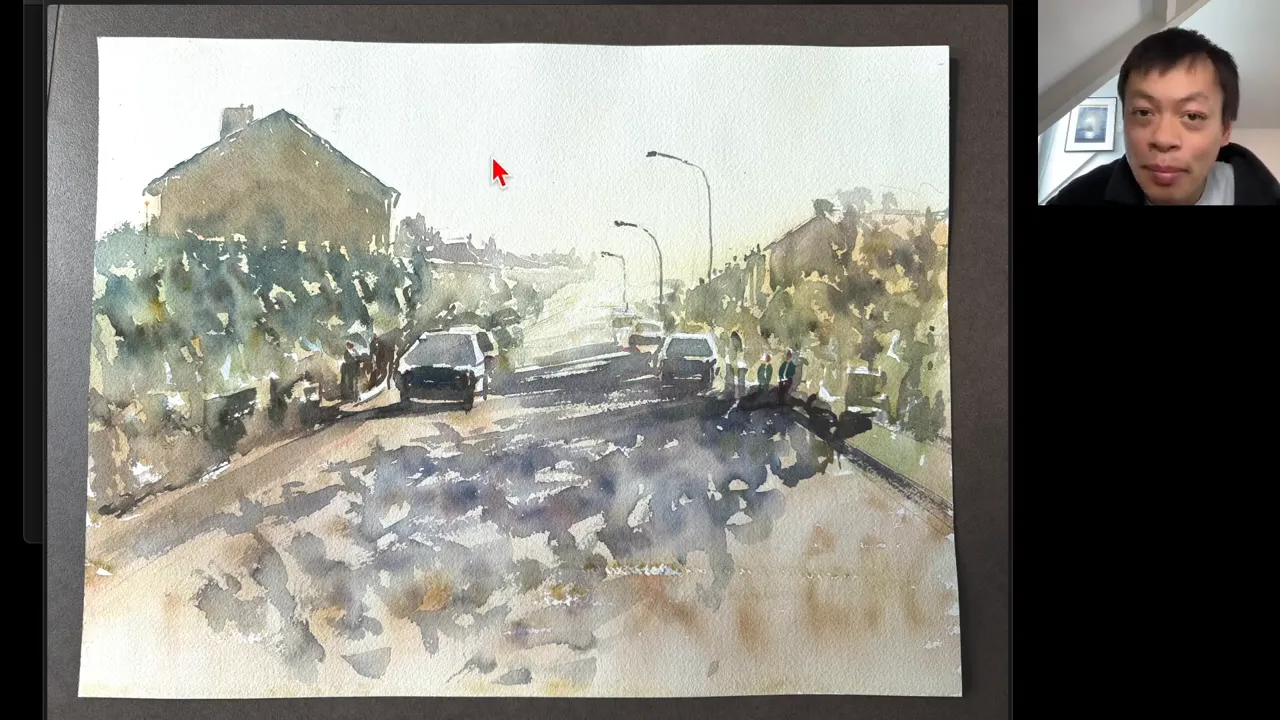
In the moment, I put everything into boxes: the first watercolor is ugly, the second one is good. In reality, the first one holds plenty of things worth keeping:
- the slightly 3D effect of the gutter, which leaves light on one of the facades;
- the lush green side, with a bit of blending;
- the shadows, some a little lighter and some a little darker;
- the cars in 3 dimensions and their perspective, which I had partly placed on the left to fill an area that felt too empty to me.
I could have recycled all of that into the second watercolor and the ones after it. I rejected everything outright. And the second one also has things to work on: too much black, too many extremely dark areas, branches that stand out too much.
Black-and-white thinking keeps you from seeing what's good in what's bad, and what's bad in what's good. Today, with my students, I try to say: "You think you failed this watercolor, but what you did in the sky is really great," or: "It has wonderful light, but this point still needs work." In my view, that's the mindset that helps you improve the most, and avoid those emotional roller coasters.
Should you keep and show your failed watercolors?
The last lesson is about rejection, about cutting yourself off from your work. I have the recording of the second watercolor, but not of the first one. I think I deleted it out of anger, because a part of me rejected that watercolor outright. Luckily, I kept the painting itself.
A student recently told me her watercolors had to be beautiful for her to show them. I told her that seeing your old watercolors, your misses, your struggles and your failures, and then what you managed to overcome, is also what inspires people. If you only show your successes, some will say: "I'll never get there anyway."
The part of me that failed that first watercolor went into the jungle and cleared the ground. It paved the way for me to see what really mattered: the light on the road. I wasn't a different person, I had simply chosen something else to prioritize. You who think you're hopeless, you're capable of the most beautiful horrors. There is beauty in ugliness, and ugliness in beauty.
I invite you to try this exercise: go back to watercolors you considered ugly and ask yourself what's good in them, and how they can inspire you and others. And keep them. When I compare what I considered a failure back then with what I consider a failure today, I can see how far I've come. What your present self calls a failure may be what your past self dreamed of.
FAQ
How long does it take to repaint a watercolor?
My second version took me about 20 minutes, compared with 1 hour for the first one. By focusing on a single aspect, I no longer had to control everything.
Is frustration bad when you paint?
Not necessarily. It can be destructive, but it can also become a stronger driver than inspiration, as long as you turn it into a priority in your watercolor.
Should you throw away your failed watercolors?
No, keep them. Looking at them again later shows you how far you've come and helps you be kinder to yourself.
If you want to finally create on your own, with a proven system instead of copying tutorials, this is exactly what you'll find here 👇
Discover The Loose Watercolor System