November 8, 2025
How to stop being disappointed with your watercolor paintings
If you're often disappointed with your watercolor paintings, it's because you set yourself an intention you can't control: "I want to make something beautiful, something I'm happy with." I suggest replacing it with an intention you really do have a hand in: before you paint, anticipate the moments where you're going to take risks. Then turn every watercolor into a game, where a miss is simply a level you play again.
Why are we so often disappointed with our watercolors?
A student told me she'd been going through a big period of doubt for 2 or 3 weeks, to the point of feeling paralyzed, and that she was very disappointed with the sea she had painted. To me, the problem comes from the intention. When you tell yourself "I want to make something I find beautiful", you have no control over that. Half the time, you're likely to be disappointed.
Some expectations are harder to meet than others, especially "I don't want to be disappointed" or "I want to be sure of what I'm doing." Those are the ones that create these big phases of doubt.
I also talk with people who tell me: "Before I even start, I drag myself down, I sabotage myself because I know I won't pull it off." And of course, they fail. It's a self-fulfilling prophecy. That's not the right intention, because you have no control over whether you pull it off or not.
What intention should you set instead?
There is one thing you do control: did you manage to anticipate the moments where you take risks?
When I play the mental movie of my watercolor, my trailer, I often ask myself: where could this go wrong? I try to spot the stumbling points, the risk zones, the places where I know I'm going to take a risk on purpose.
What makes a watercolor disappointing is when you head down a path that takes you somewhere you didn't want to go, and you didn't see it coming. If you anticipated it, it's a different story.
What happens when you anticipate the risk?
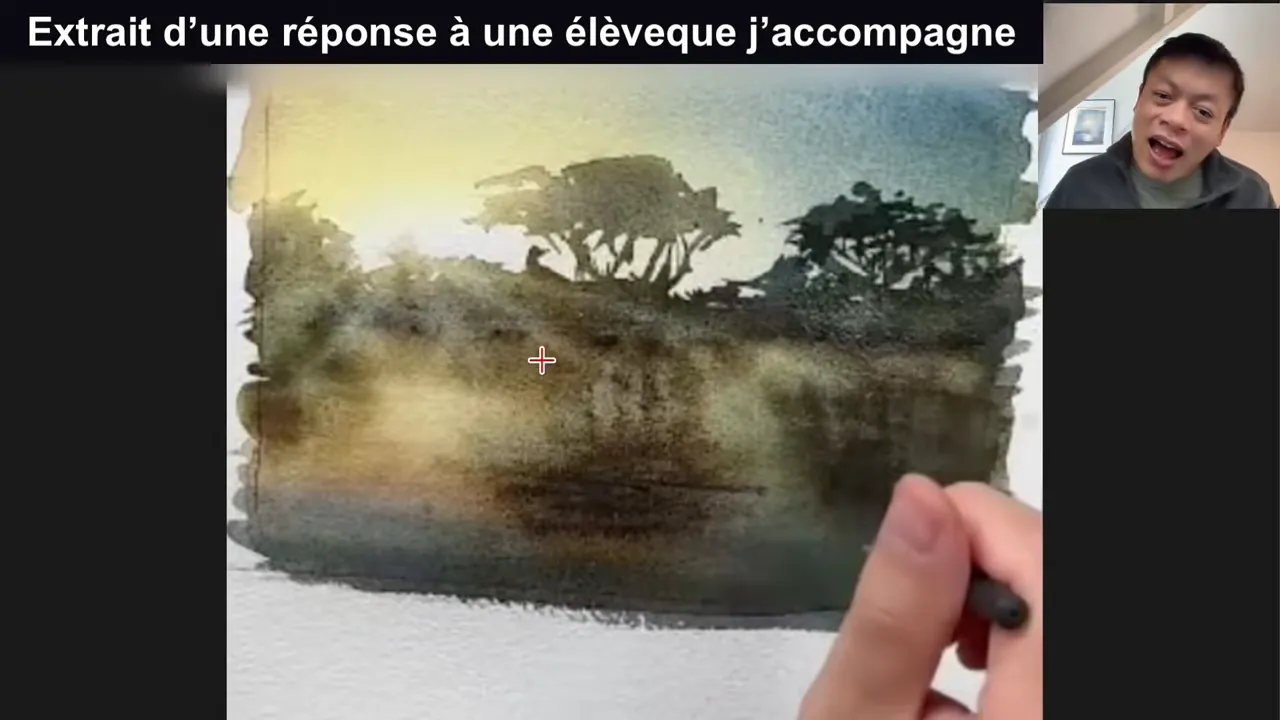
I remember a watercolor I painted during a live session, with a gorgeous pinkish, bluish sky and a beautiful reflection. I had laid the first wash, then the second, and I stopped. I hesitated to carry everything down in one flowing wash so the colors would fuse. Before doing it, I heard myself say: "Oh, that's risky, I'm not sure."
I went for it, and yes, I was disappointed. But as they say, forewarned is forearmed. Having told myself "careful, you're a bit on the edge here, it might not work the way you want", I find that hugely reassuring. I'm still disappointed, but I'm not stuck in doubt, wondering "what happened, why can't I do this."
Saying it out loud before you paint is freeing. For example: "I'm going to try a broken edge here, but there's a real chance I'll mess it up." If I do mess it up, I tell myself: "You took the risk, be proud you took it. This time it didn't work. What can you do next time so it works?"
You don't even have to anticipate it. Even when I mess up, I say it: "See, this part isn't working." Putting it into words already counts.
What if you don't feel good enough?
That's true for all of us. I don't always feel good enough either. When I tell you during a live session "I'm not really sure how this will turn out, but let's test it", once again it's putting it into words that frees you. You're not placing yourself at a level where you're not comfortable.
Impostor syndrome shows up when you try to pass yourself off as someone you're not. It's there to put you back in your place. Saying "I'm not good enough, but that's fine, let's try anyway" is the exact opposite.
I make spelling mistakes, but that's no reason to stop writing. I'm not at the level of some people who never make any, but I still do my best.
Should you paint from photos or follow tutorials?
This student wondered whether she was attempting things that were too hard by working from photos. I don't think so. Again, it's a question of intention: a photo can be very relaxed to paint if you don't set crazy expectations. That's why watercolor LEGO works so well for me, and why small formats work so well. If you miss, it's no big deal, you can start again. I also find it much more rewarding than following a tutorial.
This is my conviction: if you don't want to be a copyist, the right path is to start from photos and identify your watercolor LEGO bricks. Then you'll refine things and find your own method.
The goal isn't to follow everything I do to the letter. In the beginning, for people who have no method, that's fine. What I offer is useful to get started, and also to refine and fill in the gaps. Someone who has followed me for years wrote to me that the masterclass on brushwork I made for my French students had helped him bring awareness back to points he'd lost sight of. But at some point, it's also good to step away from it and do your own thing.
How do you turn every watercolor into a game?
Is it better to fall flat on your face? Yes, as long as the intention is right. If it's "I want to succeed at painting this photo", it's going to be tough. If it's "this photo is a warm-up, I'm going to see which points I can still improve", you've got everything to gain: you fall flat so you can bounce back better.
Progress won't come on its own. It will come if you pay conscious attention to it by asking yourself: "If I had to do it again, how would I do it differently?" For example:
- here, I need a bit more pigment;
- there, I can try a soft edge next time.
If you stay stuck in disappointment, you won't want to try again. If you're in "how would I redo it", you keep going because you want to see the result. It becomes a game. You put in another coin, play again, and see whether it's game over or whether you cleared the level.
Every watercolor is a new game, with infinite lives: you set the number yourself based on how long your painting session lasts. You can replay the same level in a different way. It's not a platform game like Mario where you go from point A to point B: you can go through point C, or set yourself a new point B. You make your own rules.
I'm telling you this as if I'd always worked this way, but that's not true. For years, I put insane pressure on myself, I told myself I was going to quit, that it was all rubbish. I realized it by painting with you, with my students, live. Bringing play back changed everything for me. When I lose motivation, I get it back, because it's as if I were playing a new game.
Also ask yourself whether the person you were 1 or 2 years ago would have been happy to paint this watercolor. It takes the pressure off. Without that question, it becomes an endless race: you keep raising the bar without ever recognizing everything you went through to get here.
FAQ
Should you avoid taking risks so you won't be disappointed?
No. Take them, but know that you're taking them. If it doesn't work, be proud you dared and look for what you could do differently next time.
Is painting from photos too hard to make progress?
No, as long as your expectations stay reasonable. A photo treated as a warm-up, on a small format, teaches you more than a tutorial followed to the letter.
Should you follow a teacher's method to the letter?
In the beginning, when you don't have a method, yes, it's useful. As you gain experience, it's worth stepping away from it to build your own method.
If you want to finally create on your own, with a proven system instead of copying tutorials, this is exactly what you'll find here 👇
Discover The Loose Watercolor System