August 9, 2026
How to simplify a complex watercolor subject with techniques you already know
To simplify a complex subject in watercolor, don't invent a new plan from scratch: remind yourself of what has already worked in the past. List the techniques you already know, then for each one ask how you could apply it to this subject, tweaking the subject (removing the sky, not painting all the water blue) until one technique fits. To choose between them, I ask 3 questions: is it fun, is it fast, is it efficient?
Why does a complex subject block you in watercolor?
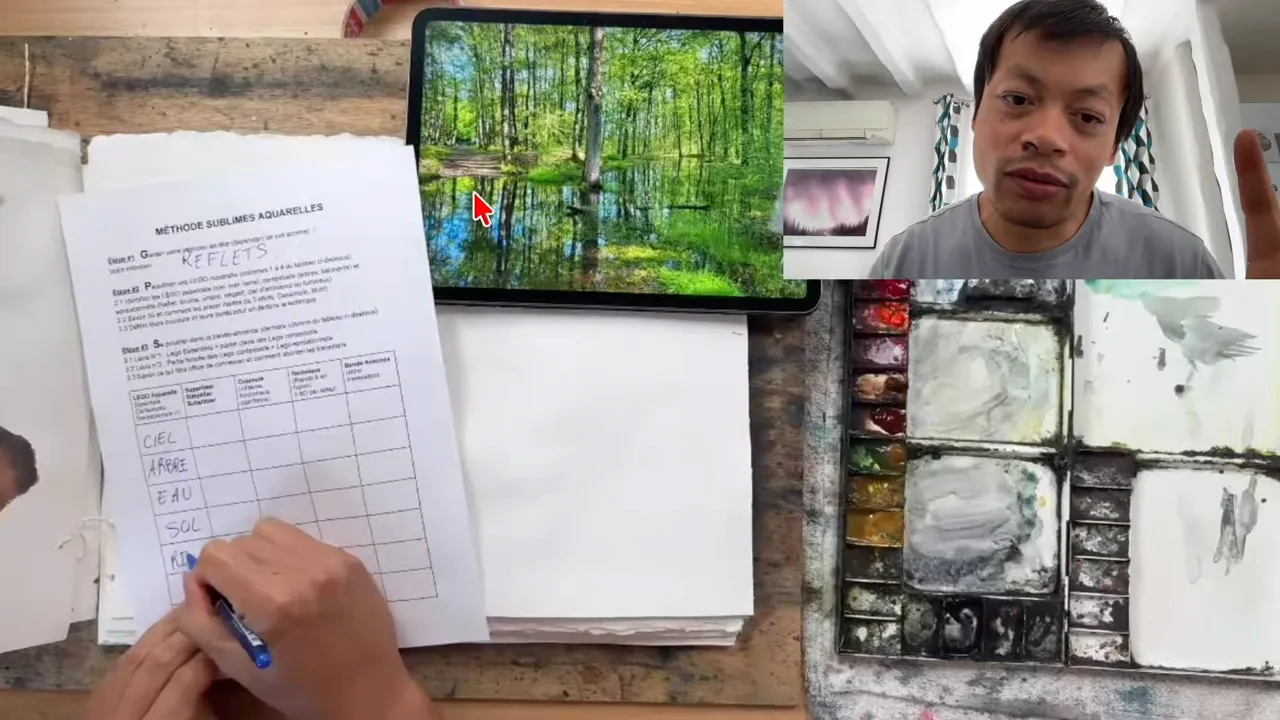
My methodology is based on listing all the elements in a given photo. The trouble starts when that list gets too long.
During a live session with my students, one of them shared a photo of a forest with water. Listing everything in the first column of my system, I had:
- the sky
- the trees
- the floor, the earth
- the water
- the reflection
There were a lot of elements, and I really didn't know how to start this watercolor painting. I spent about 10 minutes discussing it live with the students. My intention in this painting was the reflection, so should I really paint the earth? Should I really paint the sky? I didn't know how to manage each component. It turned out that the solution was already something I had done.
What is the mirror technique?
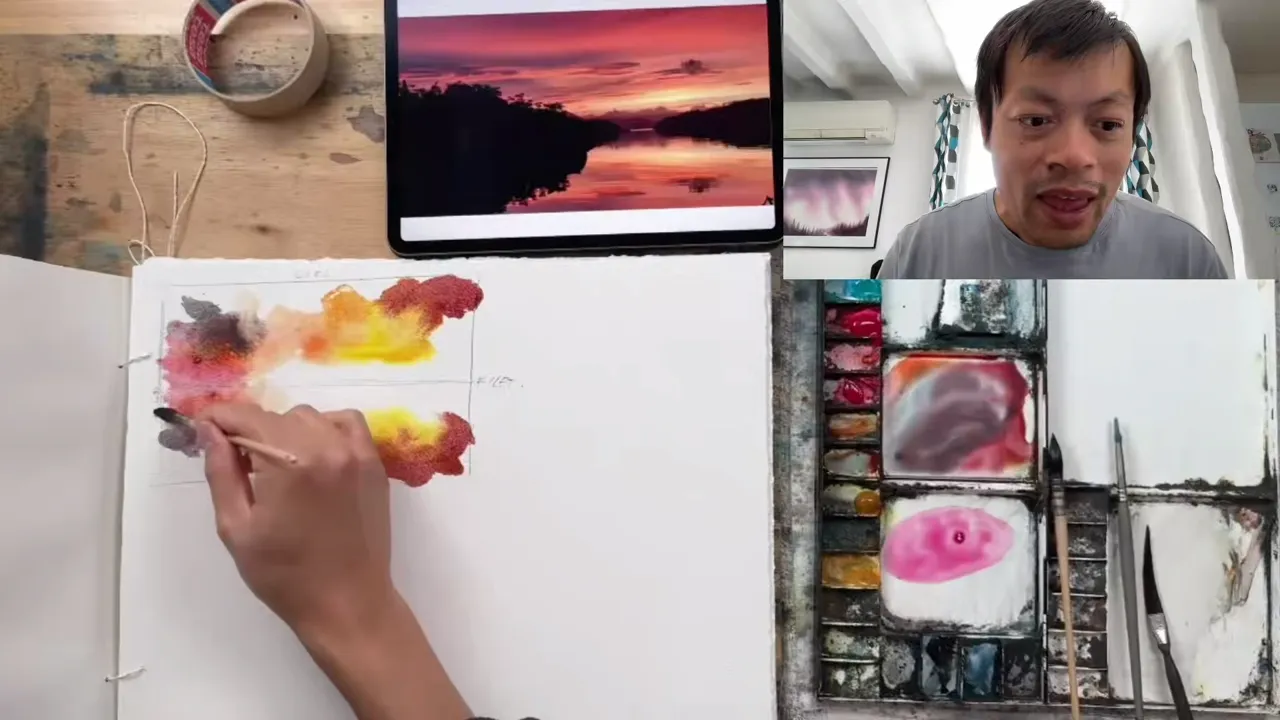
In a previous workshop with my students, the subject had nothing to do with forests or trees. It was about the sky and the sea, and in that picture the sea is a reflection of the sky. For this kind of picture I teach a technique I call the mirror technique.
- First, put down some water.
- Then add pure pigment, using the colors from the reference photo, for example yellow and orange.
- Each and every time you put a pigment in the sky, for example the yellow, you do exactly the same in the sea, at the same time.
Doing both at the same time means you don't end up thinking "I forgot to put the yellow pigment in the reflection." The result is beautiful because there is congruency in making the reflection of the sky at the same moment in terms of execution. Before, I wanted to paint the sky first and then the reflection. Now I could see that doing both at once is much easier.
How do you recycle a technique on a new subject?
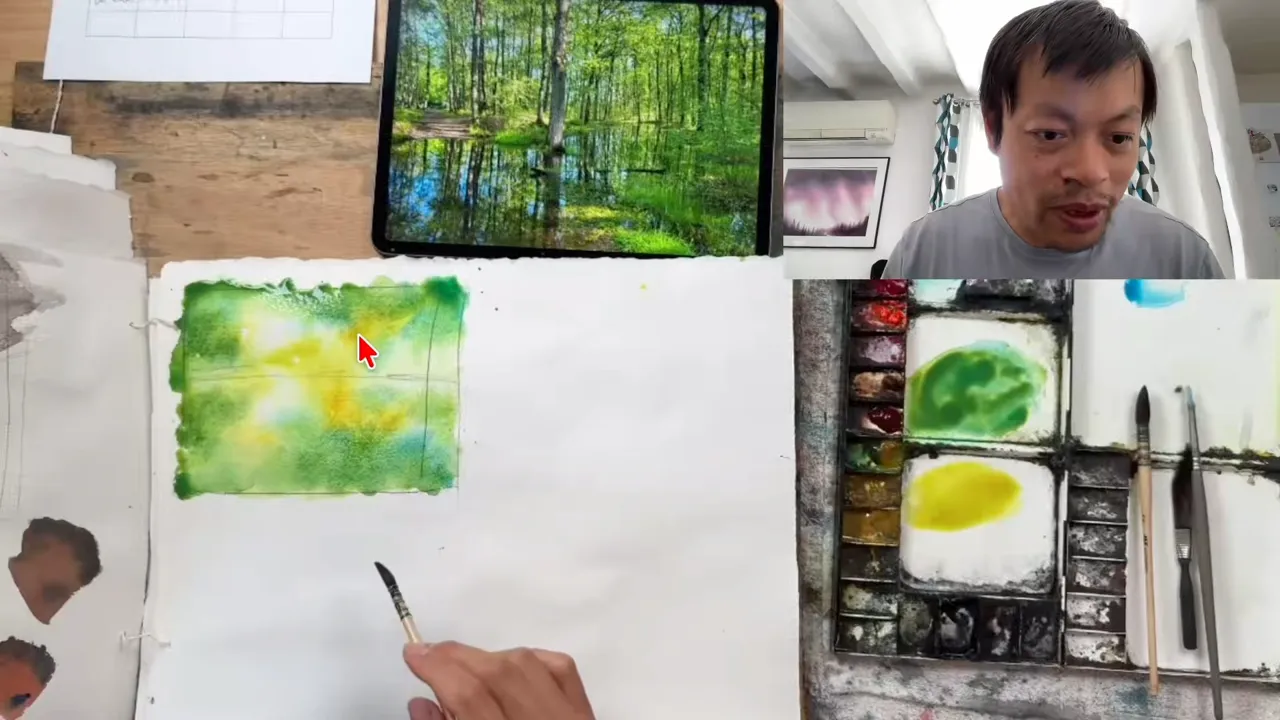
Back to the forest: I realized I wouldn't be able to come up with a good plan for this painting on its own. The solution was to recycle a previous technique, one that may have nothing to do with the current subject. Because there was a reflection in this photo, it reminded me: "Oh yes, there was this technique I used for seascapes, but it can also apply to the forest." Since I knew this technique already works, I knew how I was going to paint it.
So I put pure water first, then a little pigment, and when I put the yellow down, funnily enough it landed in the same place. Once the wash was dry, it wasn't exactly the reference photo, but the mood was there, and so was the light, thanks to the mirror technique I already knew.
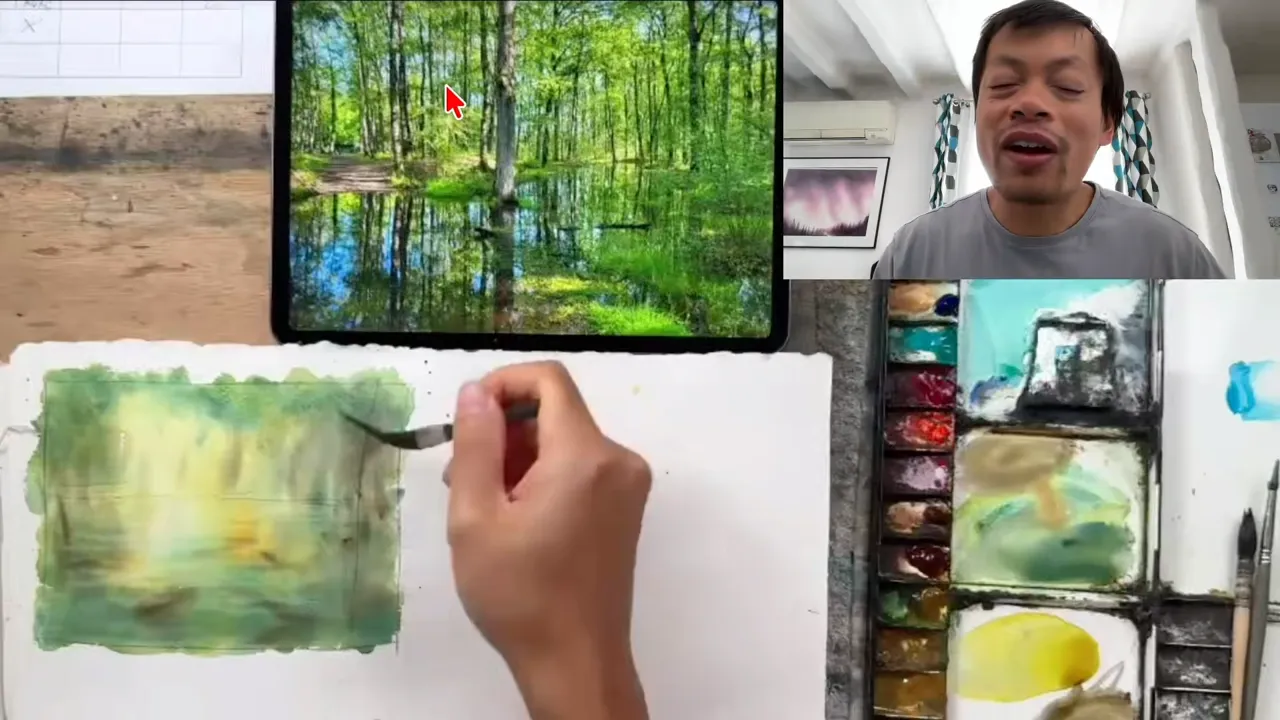
At first I didn't want to spoil this first wash because it was so beautiful. Then I told my students: "You know what, consider that this first wash is a mess, a complete failure, and we are going to put another wash on top of it." The result wasn't too bad, and I think we could improve it, but that is not the point. The point is the method.
Most of the students I coach are complete beginners in watercolor, and the paintings they made during this live session show that this trick works marvelously well.
How do you know which techniques you already master?
Take, for example, the 20 previous watercolor paintings you made. For each painting, list the technique: "this is a graded wash," "this is a wet-on-wet technique." Some paintings will share the same techniques. In the end you will have a list of 5, 10 or 20 techniques.
When you meet a complex subject, go through that list:
- Take a technique you know, whose output you know and that you know works.
- Ask yourself: how can I apply this technique to this subject?
- If you get no answer, go to the next technique and ask the same question.
By doing this for all the techniques you know, you may see that if you tweak the subject, for instance by removing the sky or by not painting all the water in blue, one technique becomes compatible with it. That tweak is the right way to simplify it.
How do you choose between several techniques?
Each person is different, but my thinking process relies on 3 big criteria when I decide to apply one technique instead of another:
- Is it fun? This is the most important one for me. Is it fun to apply this technique to this new subject or not?
- Is it fast? Can I apply it in seconds? If it takes minutes I can try it, but I'd rather it took seconds.
- Is it efficient? Does the technique give an output with a kind of wow effect? Does it create emotion? Does it create light?
The mirror technique on the forest checked all 3. It was fun because it simplified the subject a lot. It was very fast, since I already knew it can be done in seconds. And I knew the outcome could be very beautiful.
Think about your own criteria based on your own personality. Then you have a complete decision process: your list of known techniques, your list of criteria, and your complex subject. Filter the subject through the techniques filter and the criteria filter, and you will maybe come up with one technique, or one tweak of the subject, that makes it more reachable, more accessible and more doable.
FAQ
Does the recycled technique need to come from a similar subject?
No. The technique may have nothing to do with the current subject. I used the mirror technique from a sky and sea workshop on a forest, because both photos had a reflection.
Can complete beginners use this method?
Yes. Most of the students I coach are complete beginners, and they painted the forest subject by themselves during the live session using this trick.
What do you do if the first wash doesn't look like the photo?
Look at whether the mood and the light are there. You can also consider the first wash a failure and put another wash on top of it.
If you want to finally create on your own, with a proven system instead of copying tutorials, this is exactly what you'll find here 👇
Discover The Loose Watercolor System