July 5, 2026
How to paint watercolor without tutorials: 3 things that replace them
To paint watercolor without relying on tutorials, focus on one intention instead of 10,000 details, master a handful of reusable building blocks, which I call watercolor LEGO, and limit yourself to a few colors you know inside out. These are the 3 things I wish I had known before struggling for more than 10 years and painting more than 1,000 watercolors without a tutorial.
Why does copying every detail in a photo ruin a watercolor?
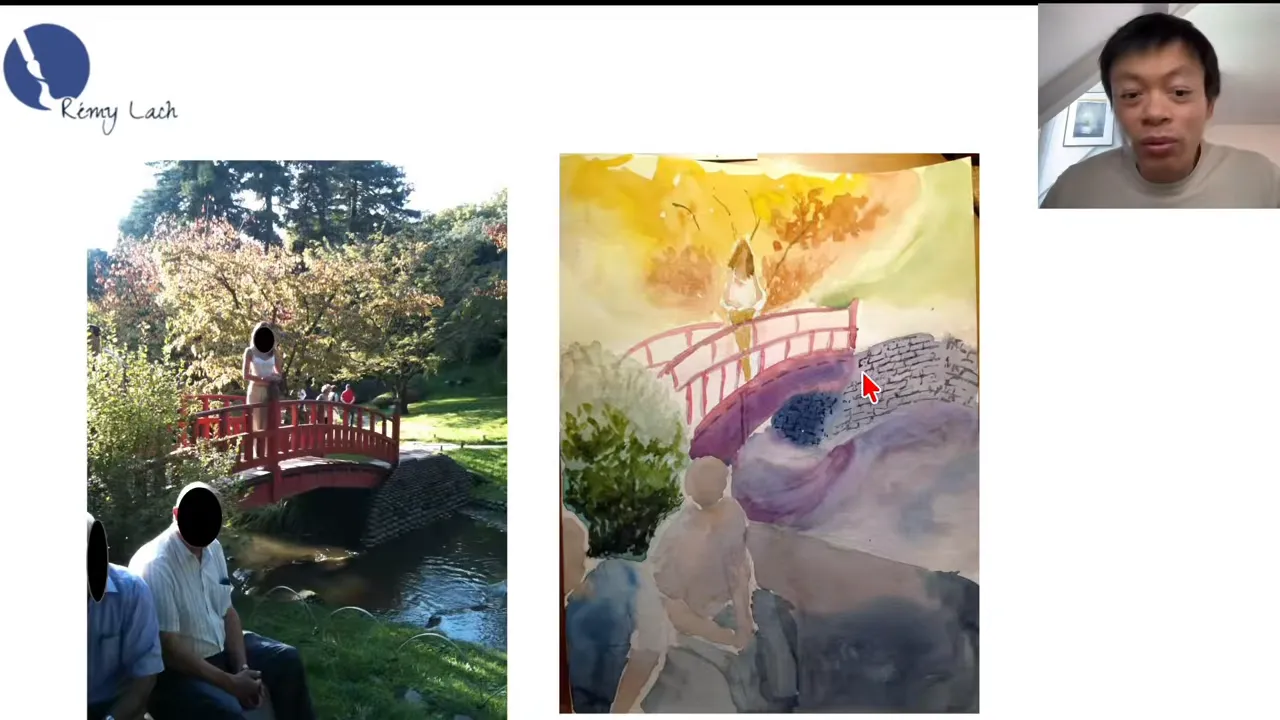
Back then, I painted absolutely everything I saw in the photo: the tree, the person, the bridge, the rocks, the foliage, the people in the foreground. The problem with getting too attached to details and wanting to paint it all is that nothing really matters anymore. Instead of focusing on emotion and light, I was focusing on a rock or a tiny brick.
Copying every detail also creates a very concrete problem. With a photo of a restaurant, this approach would have had me painting the roof, the trees, the antenna, the shadow, the facade, the railings, the parasols and the flowerpots. I would have spent 3 hours painting all the details and completely forgotten the emotion and the story I wanted to tell. On top of that, while working on a detail on the right, I would have forgotten that the watercolor was drying on the left, and I would have ended up with plenty of hard-edged rings and cauliflowers.
How do you choose an intention before you paint?
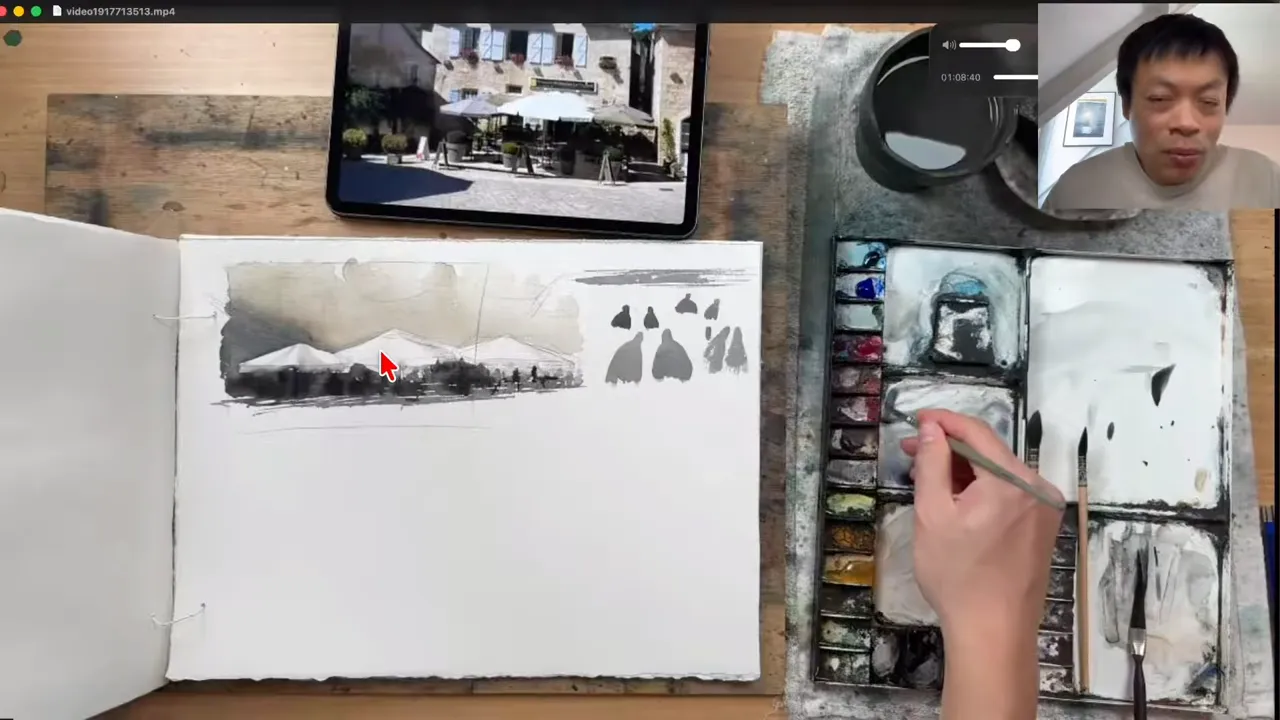
Instead of focusing on the details in the photo, ask yourself what message you want to get across and what story you want to tell.
With that same restaurant photo, I chose the scene that moved me and zoomed in on that area. What interested me was the people eating under the parasols. My story was more like: "It's summer, I'm under the parasol at a restaurant and I want to have a good time." Here is how I built it:
- I paint in negative, which means I paint around the lightest parts.
- I add the shadows I see in the photo, without bothering with all the details.
- I paint the figures under the parasol to add a little life.
At no point did I linger on the flowerpot or the menu board. I built my watercolor around that parasol scene.
Why can the same photo give you 2 different watercolors?
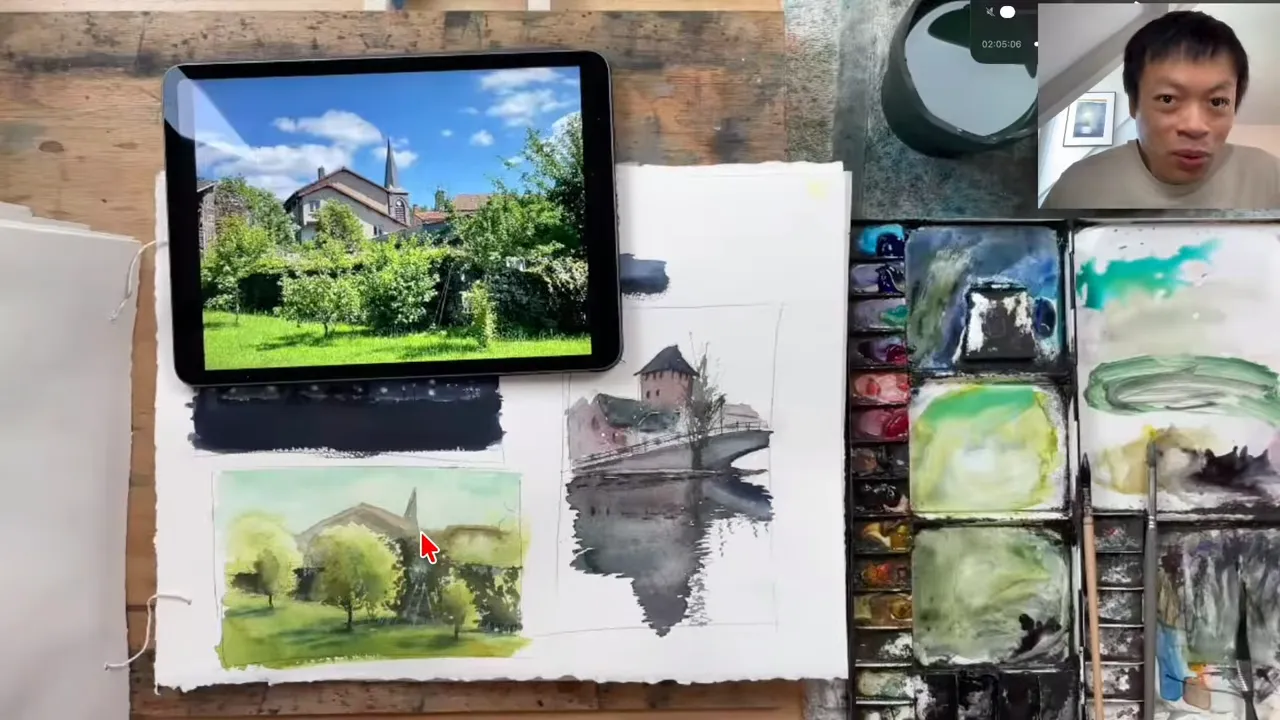
Depending on your intention, the watercolor and the result change completely. Take a photo from one of my students, where everything seems important: the clouds, the sky, the trees, the roofs, the houses, the church, the garden.
One student painted this photo without any tutorial. From my point of view, she wanted to focus on a house with the light falling on it. So the trees are there to serve the house.
During a live session, my students asked me to tell a different story with the same photo, this time around the trees. That changes the way you handle every element:
- The garden: I start with green and paint around the different trees.
- The houses: I make one stroke, then another stroke for the roof. I rushed them because they didn't interest me, they weren't the point.
- The church: I paint its roof in negative, going around my tree, which is the main element of my story.
- The sky: it stays extremely pale, because it is also there to serve my trees.
The trees become the heroes of the story, and they are what you see first.
How do you replace tutorials with watercolor LEGO?
I used to pick up a book, Les 101 techniques de l'aquarelle (101 watercolor techniques), and do everything it told me to do. After working through dozens and dozens of tutorials, I asked myself 2 questions: have I really learned anything? Do I feel more able to paint my own watercolors? The answer to both was no.
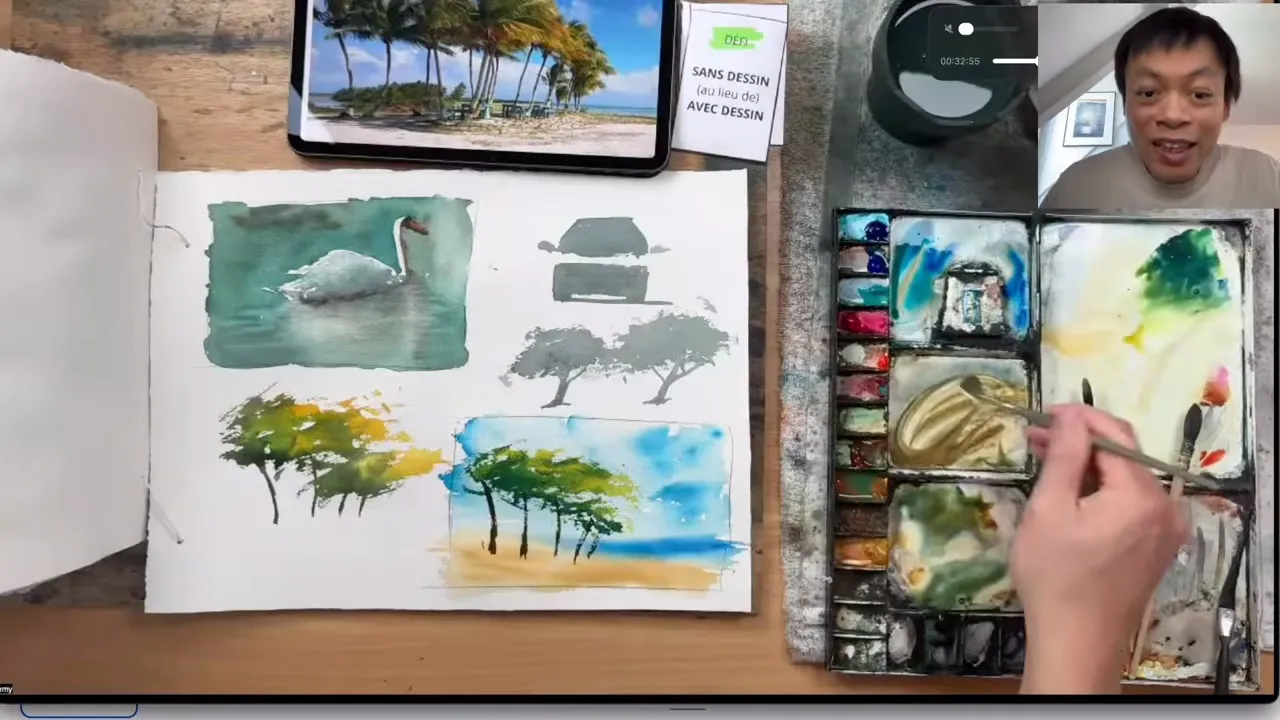
I then built 2 watercolors on completely different subjects, one of them from a photo of baskets on the beach. In both cases, I used the same mechanics, without any tutorial:
- The sky
- The sea
- The sand
- The trees
- The shadows
These building blocks are what I call watercolor LEGO, and they have replaced all the tutorials I used to follow. You don't need to mechanically follow 10,000 tutorials, because that strips you of your creativity and your critical eye. Instead, master a handful of LEGO, 2 or 3 are enough, that you can take apart and rearrange however you like.
From one watercolor to the next, you can make small adjustments. In my first example, the sand was a little dull, and in the second, a little brighter. But these adjustments come from the same source: watercolor LEGO, which let you create your own stories.
How many colors do you need to paint in watercolor?
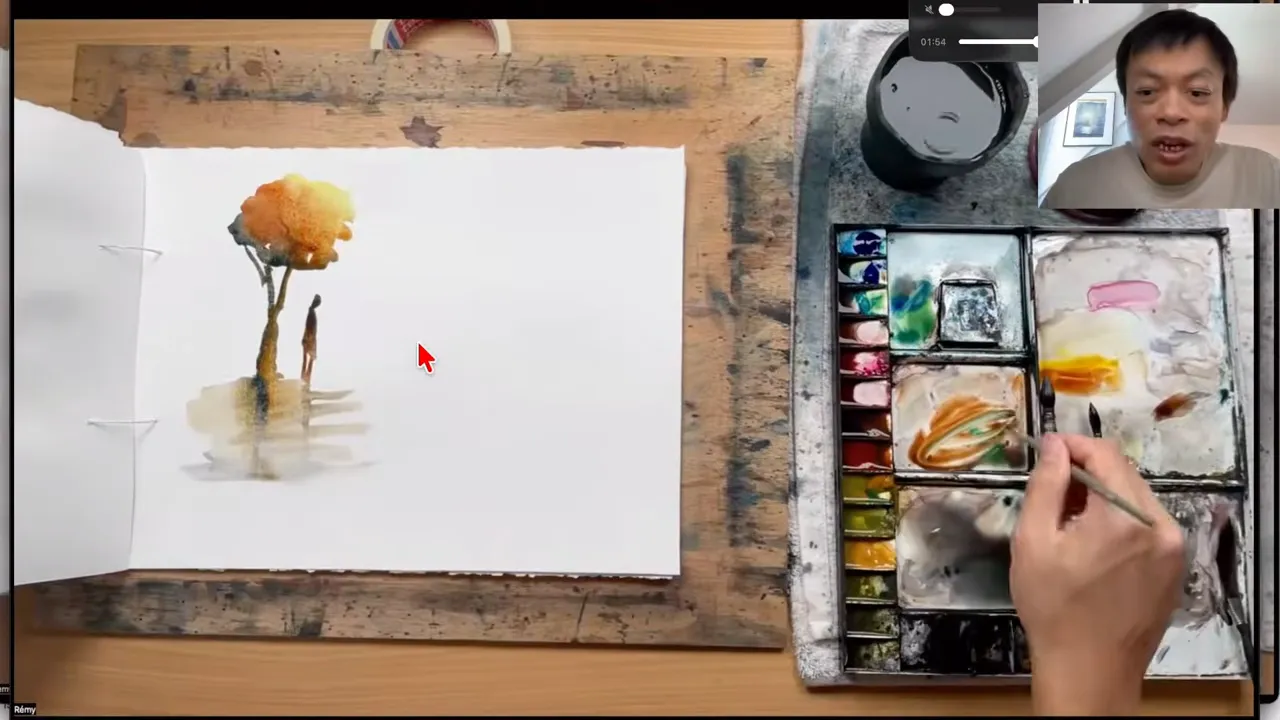
You don't need 10,000 colors. Knowing 2 or 3 colors inside out is enough to paint gorgeous watercolors.
Back then, I bought a ton of colors because I thought that painting vibrant watercolors took as many colors as there are shades. I ended up with palettes of dozens and dozens of pans that I only used once, because I realized it wasn't working. I also bought far too many brushes and palettes. Knowing how to limit myself to a few colors would have saved me 3,184 euros in supplies.
Everything changed during a live session, when a student asked me how I would paint a tree. I used only 4 colors:
- gamboge, a fairly warm yellow;
- burnt sienna;
- burnt umber;
- ultramarine blue, to darken and cool my tree.
I kept the same 4 colors for the trunk. I laid down burnt sienna with ultramarine blue at the base of the tree, then painted a figure and its reflection in burnt sienna with my synthetic brush. For another figure, I simply picked up the mix of these 4 colors already on the palette. The colors still sing, and my students exclaimed: "Wow, it's actually incredible to see that with so few colors, you can get so many different shades."
FAQ
How long does it take to paint without tutorials?
For me, it took more than 10 years, and it was an absolute struggle. I really wish I had gotten there faster and more efficiently.
What does painting in negative mean in watercolor?
Painting in negative means painting around the lightest parts. For example, I use it to paint a church roof by going around a tree.
How many watercolor LEGO do you need to master?
Only a handful: 2 or 3 are enough. They replace the dozens of tutorials you might otherwise work through, and they let you tackle completely different subjects.
If you want to finally create on your own, with a proven system instead of copying tutorials, this is exactly what you'll find here 👇
Discover The Loose Watercolor System