July 12, 2026
How to paint trees in watercolor
To paint trees in watercolor, you only need 3 techniques: the capital O tree for a big, textured mass of foliage, the A tree for cone-shaped trees like firs and pines, and the small o tree for trees made of little bubbles of foliage. When you look at a photo, you first recognize which type the tree belongs to, then you apply the matching technique, without trying to paint every leaf. This is what I call the wow method.
Why do trees look so hard to paint?
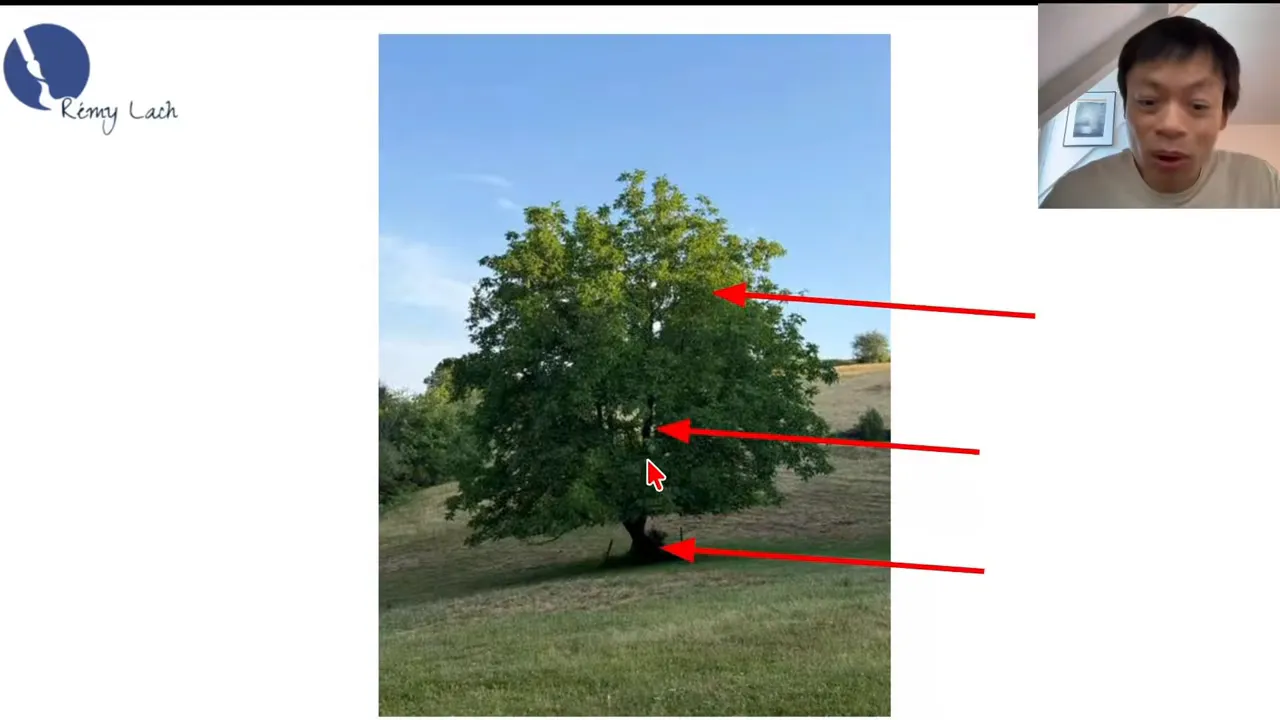
In the past, I would have told myself this subject was too hard for me: either I needed a tutorial, or I needed more techniques. When you look at a tree, the problem is wanting to paint all of it. Every little branch, every leaf, the leaves in the light, the leaves in the shadow, the trunk, the grass, the trees in the distance. There are too many things to keep track of, and when there are too many things to keep track of, you get lost and end up painting completely blind.
The key is to see a tree as something built like a LEGO figure. A LEGO figure has a head, a body and legs. A tree is the same: it has foliage, branches and a trunk.
How to paint textured foliage with the capital O tree
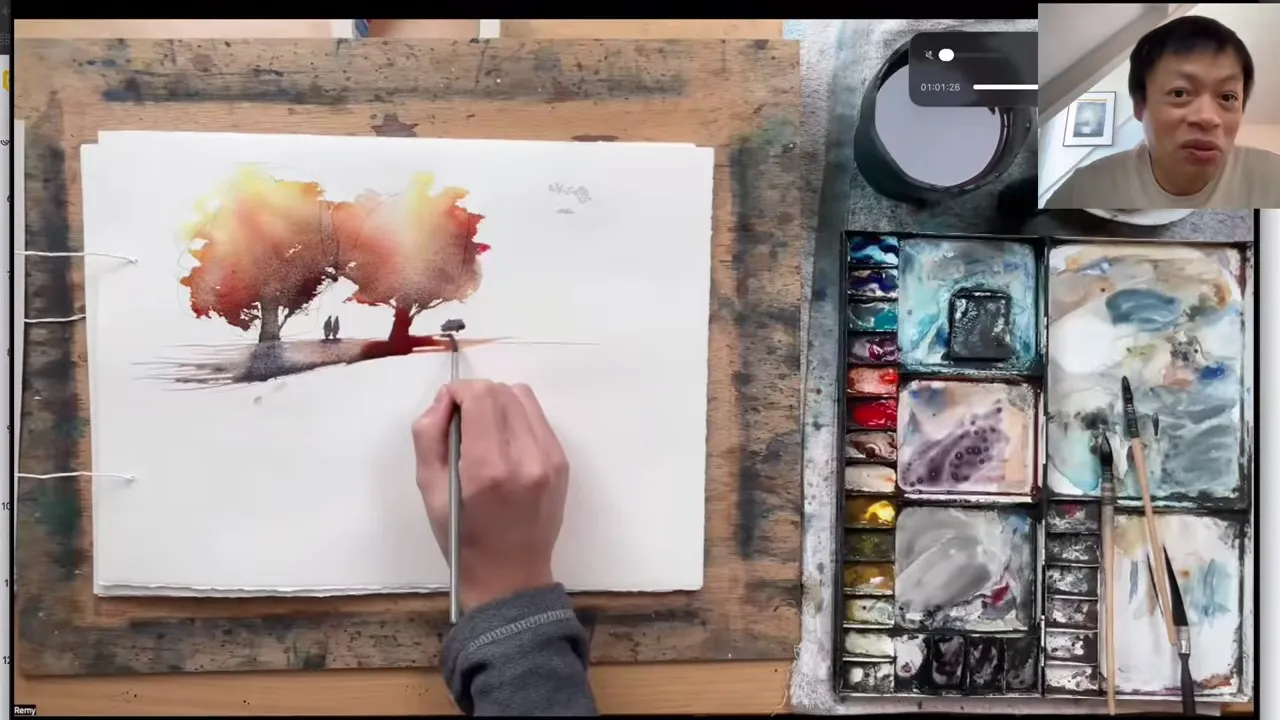
This first technique lets you paint a sketch of a tree in a few seconds. You can use any color, not necessarily green. I do recommend a brush that holds water well, though. I use a small mop brush, a size 3/0, and that is plenty.
The most important thing is the stroke. I call it an against-the-grain stroke:
- The mistake to avoid is dragging the brush in the direction of the bristles, the way you sweep a broom to gather up dust.
- What you want instead is to move as if you were pushing the broom with the handle pointing away from you. The bristles are pushed back, bending the opposite way from usual.
- You don't have to go fully against the bristles, but at least go across them, at a right angle.
- I tap lightly against the paper. The goal is not to wreck the brush.
This stroke is what creates that slightly broken, crumbly texture so typical of foliage. I can do the same thing with my dagger brush: instead of stroking it along the bristles, I rub it across the paper at a right angle. That broken effect is actually much easier to get with a dagger brush than with a mop brush, but both work very well.
I call it the capital O tree because I paint a big O for the foliage. I can then change the colors, red for example, and finish with much darker colors: the principle stays the same. Icing on the cake, the trunk is also painted with the dagger brush, with one bracket on the left and one on the right, like a pair of parentheses. After that, you tell whatever story you like: a shadow, 2 figures, a car, a little bench, a pond.
How to paint a fir tree with the A tree
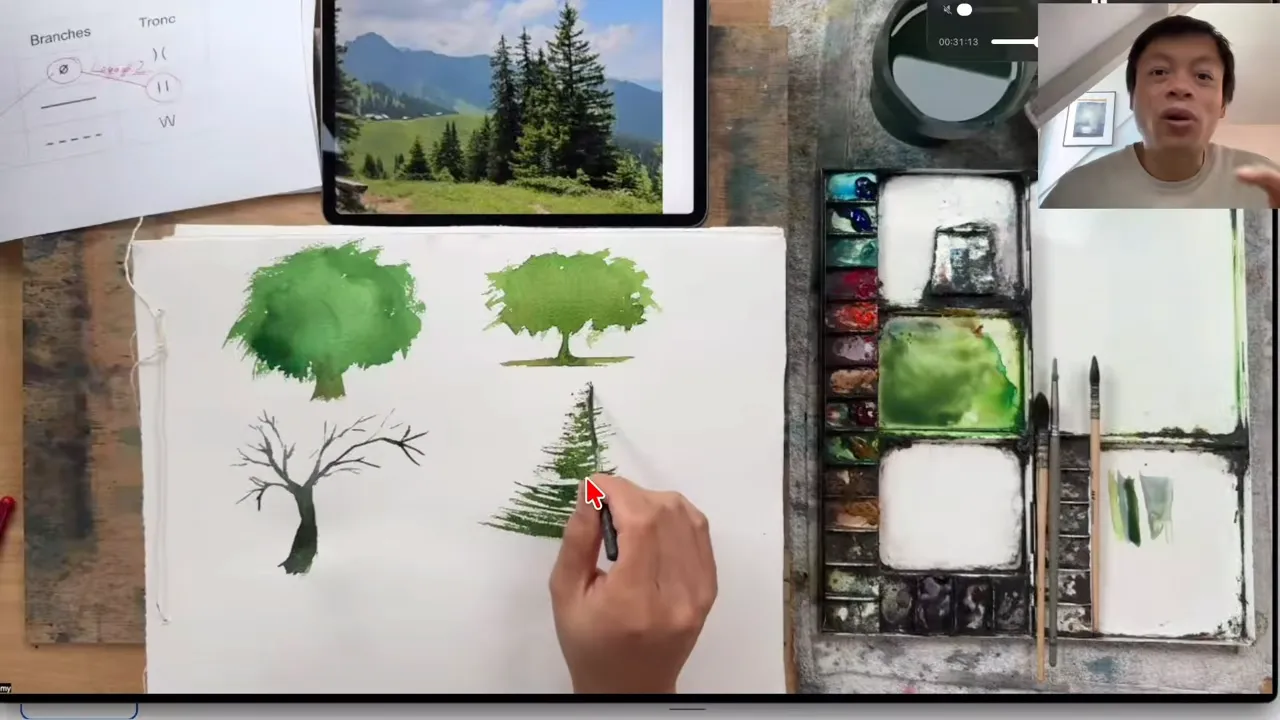
The A tree is for cone-shaped trees like firs. You need to watch 2 things: the movement of the brush and the order you paint in.
The movement is a left-to-right zigzag of the brush on the paper. This time the trunk is straight, unlike the bracket-shaped trunk of the capital O tree.
There are 2 mistakes to avoid:
- Painting with the belly of the dagger brush. I use the Da Vinci series 703, size 1. On one side, this brush has a slightly slanted curve: that is the belly. On the other side, it has long, perfectly straight bristles: that is the back. The back is what should touch the paper, to make fine marks that look like the branches of the fir. With the belly, you get thick marks that ruin the shape of your tree.
- Painting in the wrong order. I paint from the bottom up: first the main mass of the fir, then the top, where the branches are thinnest and most sparse. At the start, your dagger brush is fairly loaded with water. You release that water onto the paper so that by the time you reach the top, the brush is dry enough to give you the control for tiny marks.
How to paint a tree made of foliage bubbles with the small o tree
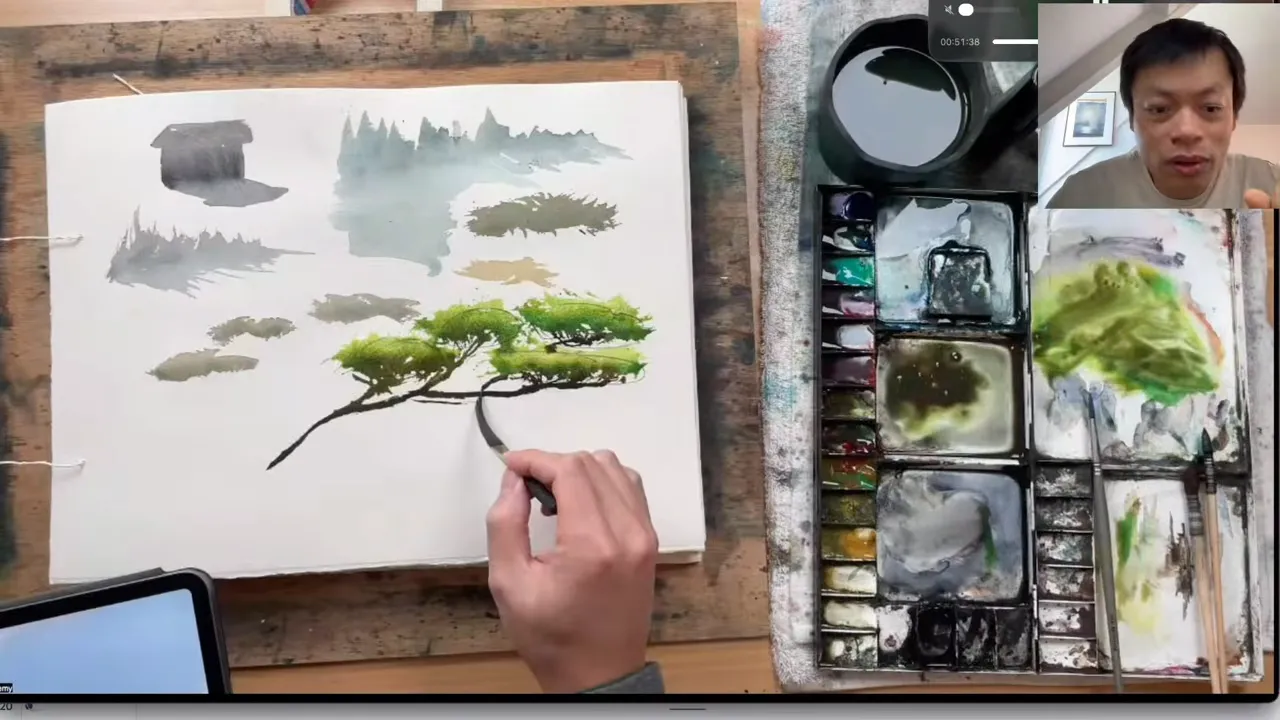
For this technique, I use my mop brush, but it works just as well with the dagger brush. Once again, any color will do. I paint small patches of foliage, one here, one there. I call it the small o tree because it is made of little bubbles placed next to each other.
2 mistakes to avoid:
- Packing the bubbles too close together. Leave gaps of a few millimeters, or even a few centimeters, between each patch.
- Putting too many in at first. This isn't necessarily a mistake, but I suggest you start with just 3 or 4 large bubbles of foliage. If you keep adding more, it can quickly become too much. Get comfortable with a small number before moving on to a larger one.
Then I paint the trunk, followed by the different branches. On a subject I painted while working with a student, you could see lots of branches coming out of the different clumps of foliage. So I added tiny branches coming out of the foliage, then linked them together. That was an adaptation to that particular subject, but the structure is still a small o tree.
How to paint your own trees from a photo

To go from a photo to your watercolor, I use the wow method:
- Take one of your own photos of trees.
- Recognize the type of tree: is it a capital O tree, an A tree or a small o tree?
- Apply the matching technique.
On a subject that seemed to call for a tutorial, you might have thought it was a capital O tree, but I chose to go with a small o tree instead. I put in lots of them, more than I strictly needed, and that's fine. I filled each little o with colors completely different from the reference photo, a bit of brown, a bit of blue, then painted the trunks and the branches. My students were genuinely amazed: "Wow, that's so beautiful." I simply told them I was applying the wow method.
In my examples, I moved away from the reference photo because I was focused on my technique and I trust it. During my class on trees, 2 students used the A tree, each in their own style.
FAQ
What brush should I use to paint trees in watercolor?
I use a small mop brush, a size 3/0, which holds water well, and a Da Vinci series 703 dagger brush, size 1. For the A tree, use the dagger brush, with its back touching the paper.
Does a dagger brush or a mop brush give better foliage texture?
Both work very well for the broken, crumbly effect, but it is much easier to get with a dagger brush rubbed across the paper at a right angle.
Do I have to use green to paint trees?
No. You can use these techniques with any color, red for example, and move completely away from the colors of your reference photo.
If you want to finally create on your own, with a proven system instead of copying tutorials, this is exactly what you'll find here 👇
Discover The Loose Watercolor System