January 31, 2026
How to paint a sky in watercolor
To paint a watercolor sky without ending up with flat, muddy blotches, I use a 3-step method. First, I identify the type of sky: light, clear or chromatic, each with its own technique. Then, if needed, I add cotton-like effects for volume, and finally light effects, which I create by adding water, not by lifting.
Why my watercolor skies used to be flat and muddy
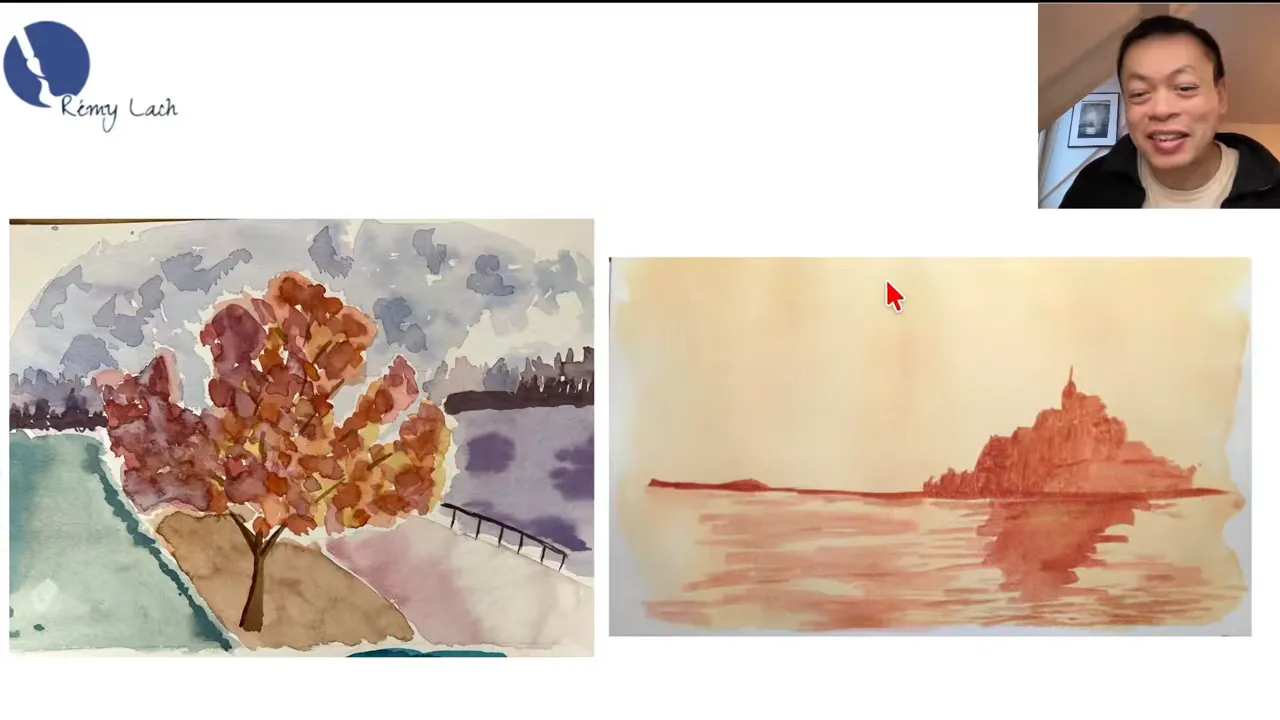
When people see my skies, they often assume I've been doing this my whole life. Not true. I used to get big blotches and completely flat skies. The difference between those skies and the ones I paint today is that back then, I was painting totally blind. I had no idea there were different categories of sky, and I kept ending up with the muddiest skies you can imagine.
Today, I look at a sky and think: "This one is more of a chromatic sky, so I'll use the light bridge technique." Or: "This is more of a light sky, so I'll use the basketball technique." That's what I call the art of the 3 skies.
These techniques also help you loosen up: you can tackle much bigger formats with wider gestures, or spend 2, 3 or even 4 times less time on a sky. Where I used to spend an hour or more on a sky, today I spend 10 to 20 minutes, without a single pencil line.
Step 1: what type of sky are you dealing with?
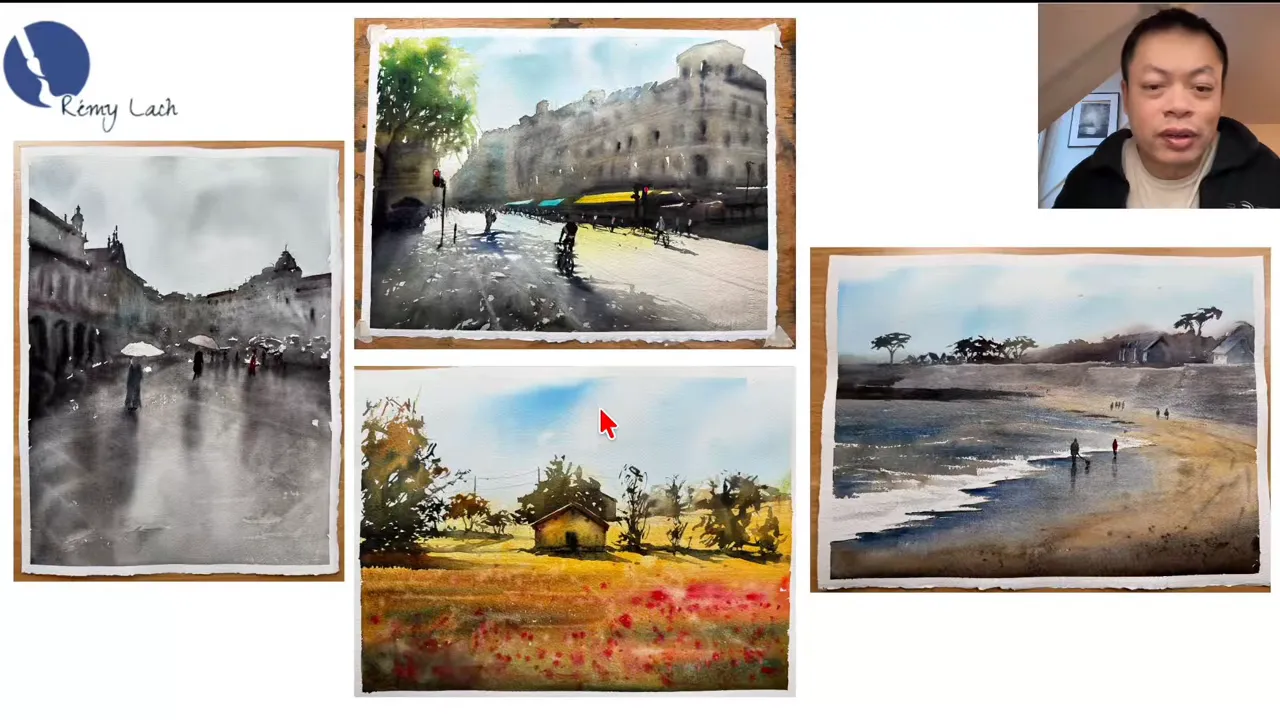
The light sky and the basketball technique
The goal of a light sky is to go unnoticed, because the sky isn't the subject. The subject is, for example, a rainy mood, an urban atmosphere, a house in the countryside or a beach in Brittany. But to avoid a completely flat sky, you still need to bring in a minimum of variation, more or less depending on your sky.
For this, I use the basketball technique. When you play basketball and dribble, you bounce the ball off the floor. Here it's the same thing: I bounce the brush on the paper with different levels of pigment, and that's what creates all those subtle variations. It's the technique I use most often, because 80% of the watercolors I paint aren't about the sky. If there's one technique to master for your skies, it's this one.
The clear sky and the relay technique
A clear sky, usually a blue sky, calls for a completely different approach. When I started, I'd make one horizontal pass with my brush, then another, and end up with really ugly stripes. The challenge isn't only getting your pigments to blend, it's also bringing in enough depth.
To avoid that striped look, I use the relay technique:
- Identify the few colors that make up your sky. I usually use 2, sometimes 3.
- Place them like runners in a relay race. The first leg goes to a fairly light, pale blue.
- That blue hands the baton to a second, slightly stronger color.
- The last leg goes to the runner who does the final sprint: a deeper blue.
It was when I discovered I could pair bright, pale colors with dark, deep ones that my clear skies stopped looking flat.
The chromatic sky and the light bridge technique
A chromatic sky combines warm and cool colors. Think sunset, dusk or dawn: oranges at the horizon and blue as you move away from it, or warm colors in the center, where the sun is, and cool ones further out. It's more complex than a clear sky: if you only look at the top part, it's a blue sky, but because of the orange part, you can't handle it the same way.
At first, there was a war between the blue and the orange: the blue mixed into the orange and gave me the ugliest gray you can imagine. The day I understood that there was an orange town on one side, a blue town on the other, and a bridge of light between them, my chromatic skies started to glow. The light bridge technique is about creating that space, what I call a ceasefire zone, where the 2 colors stop fighting and instead meet gently until they finally blend together.
I invite you to take 2 or 3 skies you'd love to paint and look at them through this lens: light, clear or chromatic?
Step 2: how to create soft, cotton-like clouds in a watercolor sky
Cotton-like effects bring volume, depth and variety. They aren't required: a clear sky doesn't necessarily have any. But often, you paint the sky as a first layer and then add the cotton effect on top, for example a clear or chromatic sky later covered with dark clouds. There are 3 cotton-like effects.
- Dark clouds, with the double impact technique. This is the technique I used for a dusk watercolor exhibited at the Carrousel du Louvre in Paris. A first pass on damp paper suggests the different clouds, then a second pass builds much more volume, with darker areas inside the clouds. You can adjust the density to go from a light, airy effect to a dense one, and the whole thing is super fast.
- Light clouds, with an avoidance technique. Unlike dark clouds, you don't paint the sky and then the texture: you paint around the white clouds and only paint the sky, whose darker color makes the clouds stand out. The transition between sky and cloud can be soft or hard.
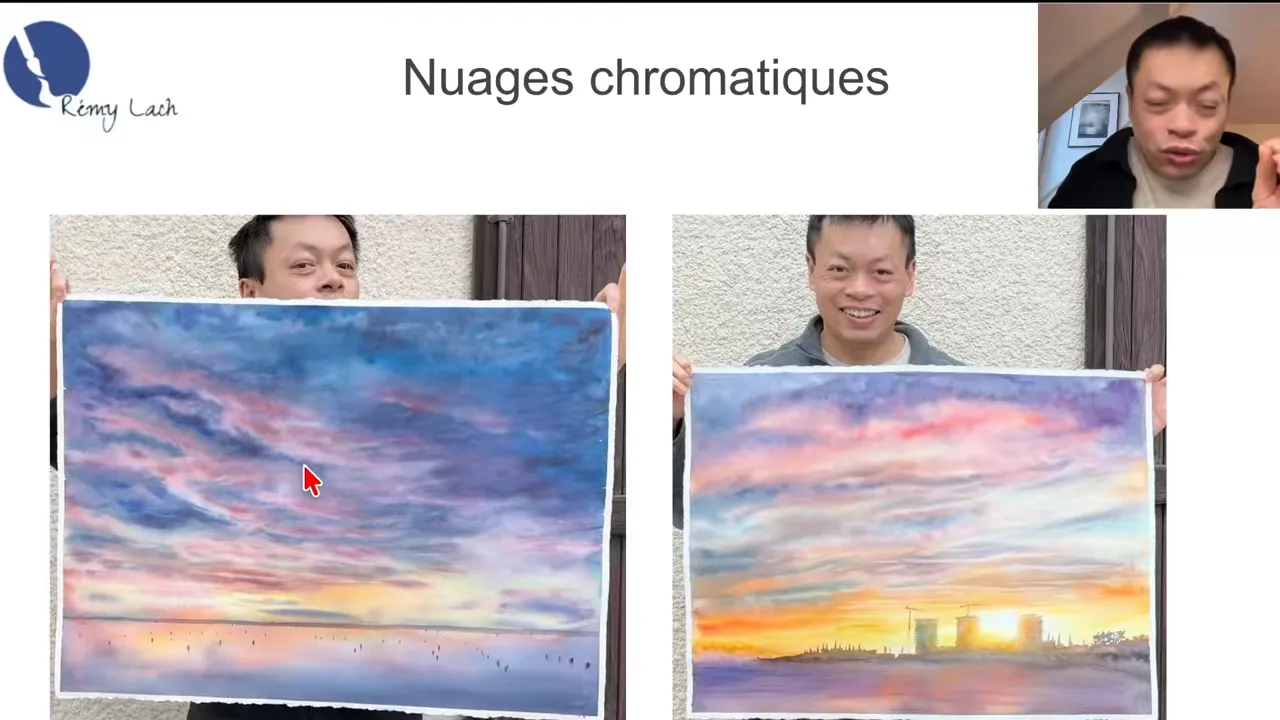
- Chromatic clouds. Like the chromatic sky, the cloud has a light, rather warm area (pink, orange) and a cooler area (blue, purple) that brings density and volume. You use the light bridge technique, but on the scale of a single cloud.
For me, chromatic clouds are one of the hardest techniques in watercolor. You have to keep the clarity and warmth of the light area against the depth of the cool areas, with a light bridge between the 2 that takes Swiss watchmaking precision. The balance has to be spot on to get the colors to blend, with no purple stripe and no pink stripe. It took me years to paint them, first because I didn't even know they existed: to me, clouds were either dark or white.
Step 3: how to add light to a watercolor sky
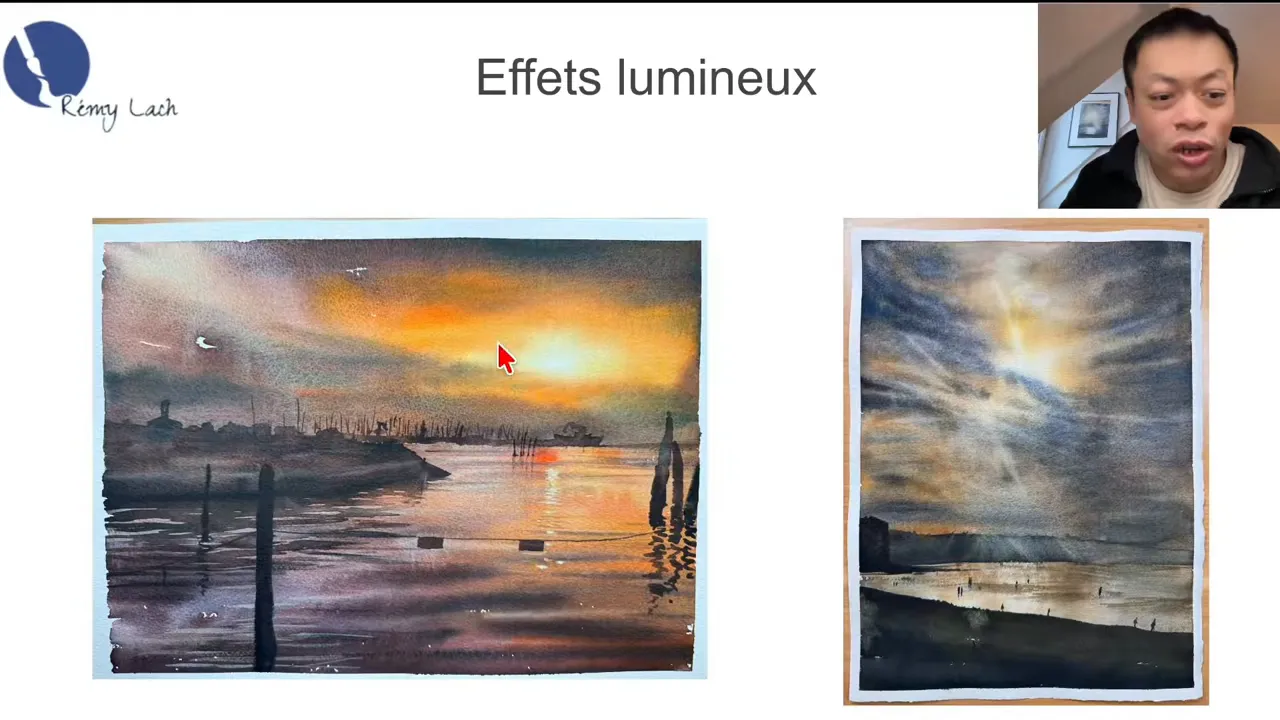
Light effects aren't required for a beautiful sky, but they make it sing. People often think I use lifting, which means picking up pigment to bring back the white of the paper. Not at all: I find that lifting dries out your wash, and you lose the benefit of the colors blending.
Instead, I recommend adding water, which pushes the pigments away and creates a lighter area, what I call channels of light. You don't dry out your paint layer and you keep the colors blending. It may sound counterintuitive, but it works like a charm.
The only thing to watch is how wet the paper is:
- Paper too dry: you get blooms.
- Paper too wet: you can't create channels of light, the water washes out your colors and carries your pigments away, and you lose the benefit of your first layers.
FAQ
Which sky technique should I master first in watercolor?
The basketball technique. Since most of my watercolors aren't about the sky, it's the one I use most often.
Why do the orange and blue of a sunset turn gray?
Because the 2 colors mix directly. By leaving a ceasefire zone between them, they meet gently instead of turning muddy.
How do you lighten part of a watercolor sky without lifting?
Add water into the paint while it's still damp. Avoid paper that's too dry, which causes blooms, or too wet, which washes everything out.
If you want to finally create on your own, with a proven system instead of copying tutorials, this is exactly what you'll find here 👇
Discover The Loose Watercolor System