October 24, 2025
How to paint a glowing forest in watercolor
To paint a glowing, light-filled forest in watercolor, I work in 4 steps. First the background, to keep the colors vivid, and I let it dry completely. Then the stairs, then the bridge, painted in negative space with the trees, and finally the rocks, which I suggest instead of detailing every single stone. You can also practice each of these elements on its own, as a mini exercise that takes just a few minutes.
What are the 4 steps to paint a forest with stairs?
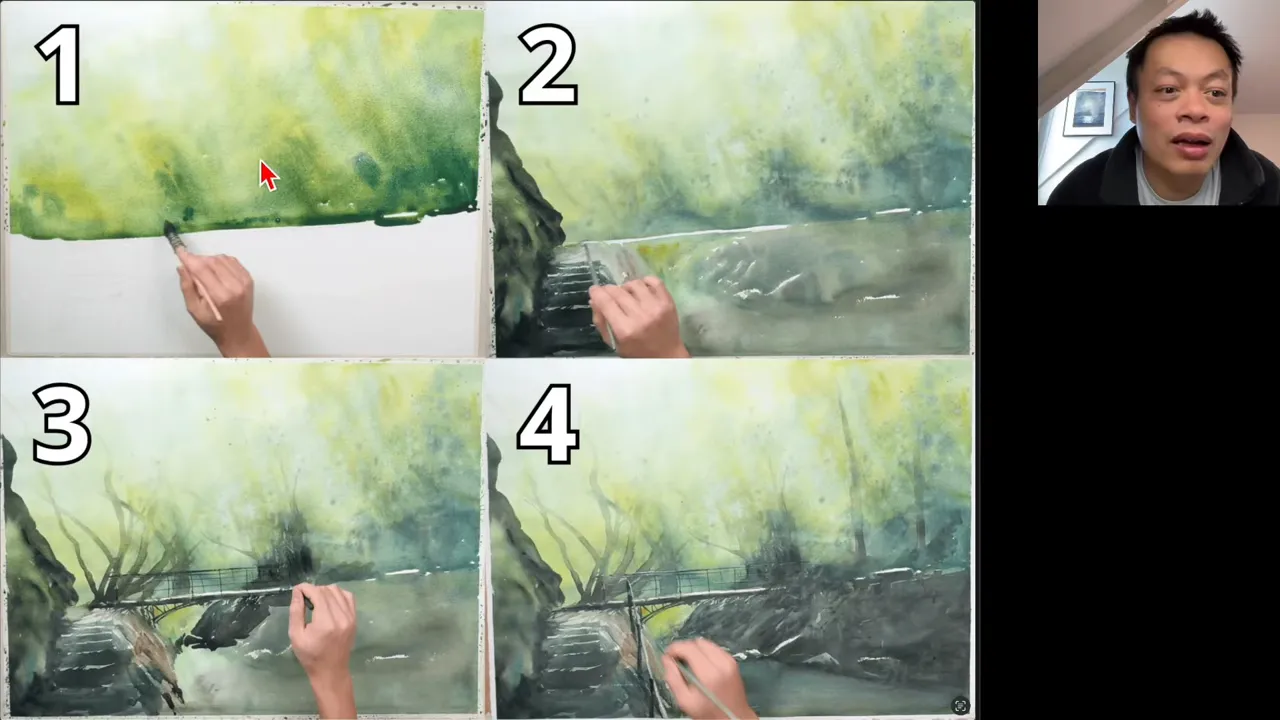
- The background. I paint it first to get vivid colors and keep them that way. Once this first wash is down, I let it dry completely.
- The stairs, with the rock. This step was critical for me, because the stairs are the path we take to enter the painting. There's a symbolic meaning behind them, and I didn't want to rush it.
- The bridge, painted in negative space. I make it appear by painting the forest trees around it, without painting every tree.
- The rocks. I handle them the same way, by suggestion. The idea is to get an overall mood, a real stony texture, with a few finishing touches, especially on the railing, which also help guide the eye.
The painting is fairly large: a full sheet, 56 x 76 cm (22 x 30 in). It took me 1 hour 20 minutes, tops.
Why paint with large, sweeping strokes?
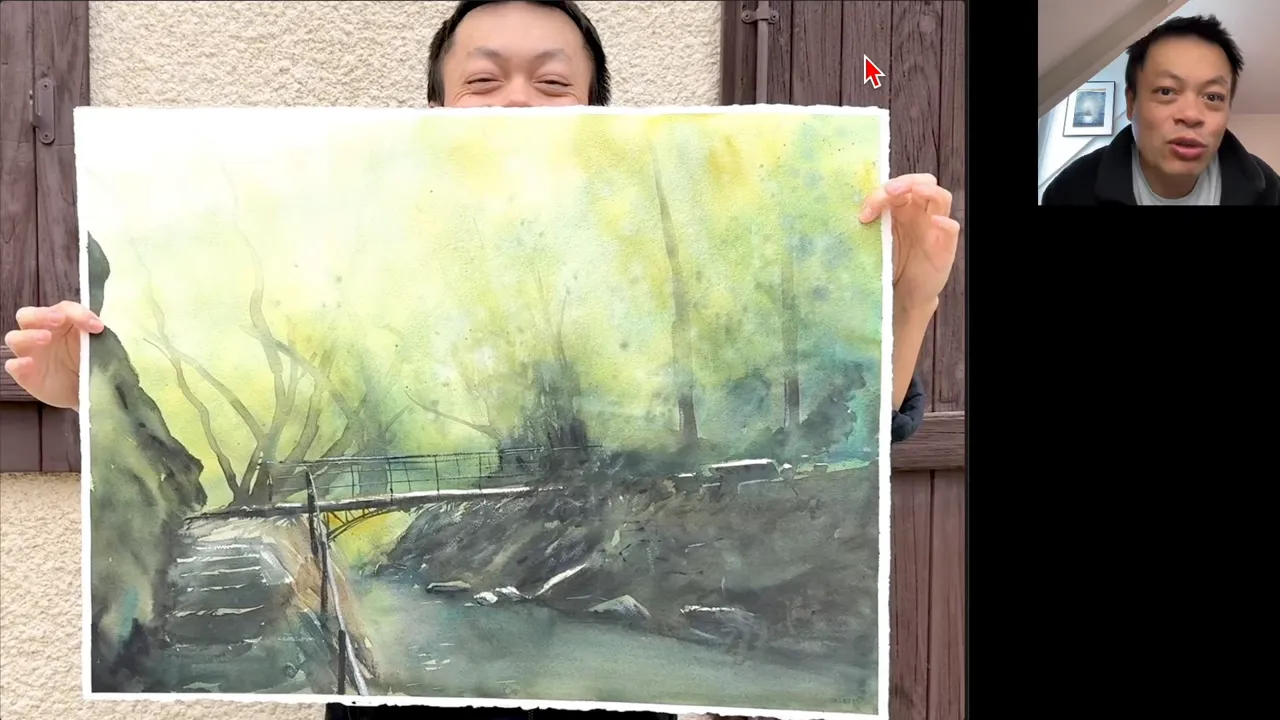
Here's the question I'd like you to ask yourself about your current technique. If you overwork your paintings, if you paint with tiny, fiddly strokes for example, does that technique let you paint on a larger scale? With the same looseness, the same gestures, the same mixes, and without necessarily spending much more time on it?
If the answer is yes, you have a truly efficient technical toolkit. With tiny, fiddly strokes, it's much harder to scale up. That's why I teach painting with large, sweeping strokes. With small strokes:
- you waste time;
- the paint dries much faster;
- you get far more blooms and backruns.
With large strokes, not only can you paint bigger, you also save time and feel lighter, looser when it's time to paint.
Trusting your technique enough to paint much larger watercolors is part of that looseness. It's like public speaking: if you can give the same talk with the same techniques to 1 person, 10, 100 or 100,000 people, everything flows much more easily and feels much lighter, even when the pressure is higher.
What are the common mistakes when painting a forest with stairs?
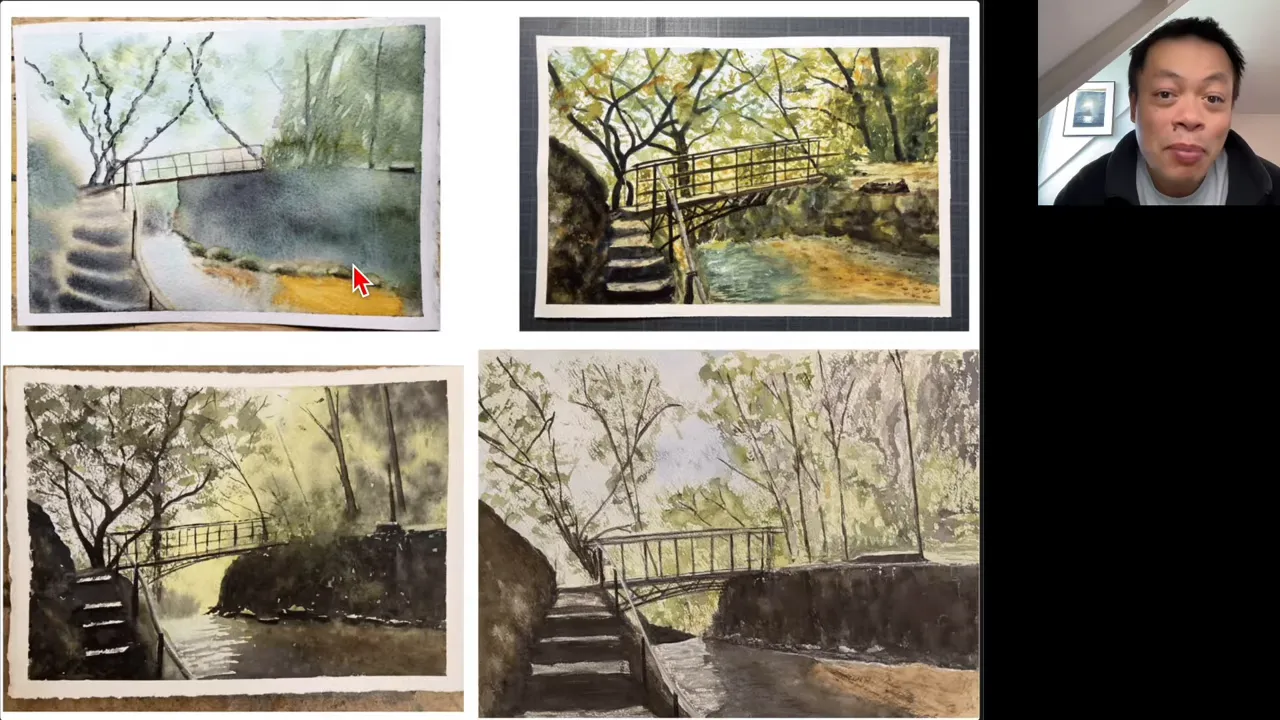
Looking at my students' paintings of this subject, I spotted 4 problems:
- A background that's too pale, which keeps you from bringing beautiful light into your painting.
- Trees that clutter the painting and eat up the whole first layer of paint, the first wash.
- Steps that are too black, so the stairs become hard to read.
- A rock that lacks texture.
My solution is to tackle each of these problems separately, with a mini exercise for each one.
How do you practice each element as a mini exercise?
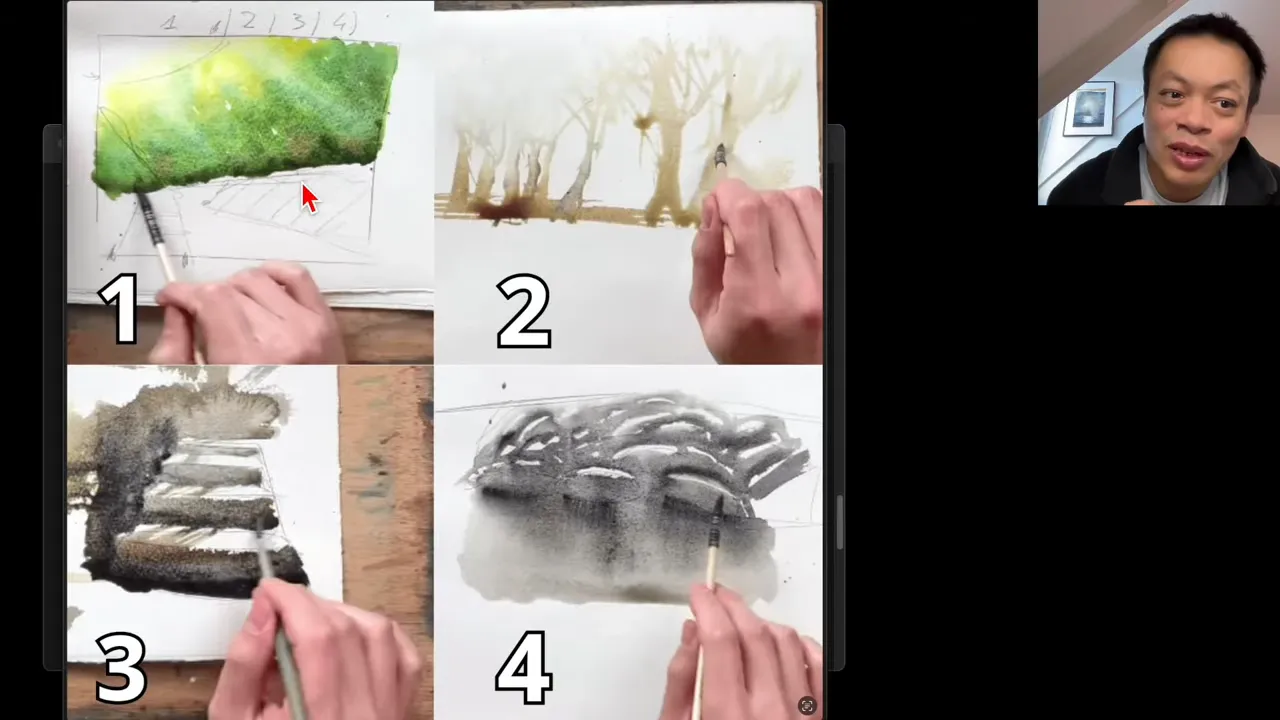
The background. This is the exercise we spent the most time on, a good hour, because there's a technical subtlety to it: in how you mix the colors, how you apply the water, how much pressure you put on the paper, and how quickly you lay down the pigments. It's also about rendering the light rays in a subtle, suggested way, without leaving a big white streak through your background.
The trees. The goal is to paint trees that are suggested, full of light, and still recognizable.
The stairs. We tend to treat every step the same way. In reality, there's depth, so perspective to take into account, but also light: some steps are brighter than others, because the light source comes from the background and needs to spill onto your stairs. That's what makes them both readable and full of light.
The stones. The work here is on texture, and on the stones with their reflections in the water.
The complete painting took me about 1 hour to paint. Each of these exercises takes a few minutes at most. From one complete painting, you can pull out a few mini exercises that let you work on one specific thing. This makes the technical side simpler and gives you instant results: in just a few minutes, you have trees bathed in light, a background with dazzling light, stairs in perspective, stones with their reflections.
Then you can focus on a single exercise, or combine them however you like, with the colors that appeal to you and bolder light rays, to make your own watercolor and break away completely from the photo. And have fun doing it: it's really stimulating, but it's also a lot of fun.
How can other painters inspire you to break away from the photo?
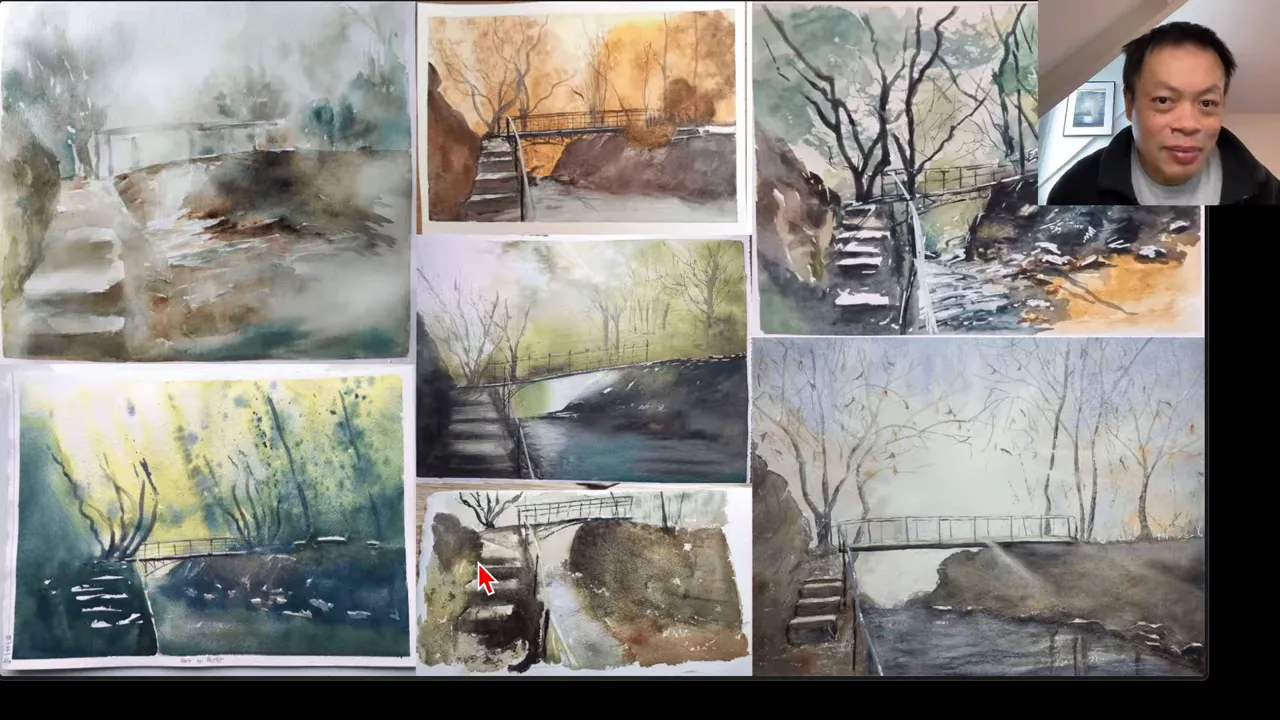
When a community paints the same subject, every subject can become fertile ground for a future painting. My students had a few days to paint this subject without me showing them anything, and I found their paintings fascinating. One of them had a misty, mystical, mysterious atmosphere that I found incredibly inspiring.
Seeing what others paint gives you so many ideas for your own watercolors, away from the photo. You can also ask yourself: "What have I painted before around this theme of forests, of nature, that worked well? What can I bring into this new subject?" If you take a class in your town, or if you work on the same subject as other artists, it's a unique opportunity to draw inspiration from what they do and bring it into your own practice.
FAQ
Should you let the background dry before painting the rest?
Yes. I lay down the background first to keep the colors vivid, then I let it dry completely before moving on to the stairs, the bridge and the rocks.
How do you keep watercolor stairs readable?
Avoid steps that are too black, and don't paint them all the same way. Think about perspective and about the light coming from the background.
Can you paint a large watercolor forest without spending hours on it?
Yes, if you paint with large, sweeping strokes. My full-sheet painting took me 1 hour 20 minutes, tops.
If you want to finally create on your own, with a proven system instead of copying tutorials, this is exactly what you'll find here 👇
Discover The Loose Watercolor System