September 19, 2026
How to loosen up in watercolor when you have an analytical mind
To loosen up in watercolor when you have an analytical mind, you don't throw away what you know. You accept that precise drawing and accurate color aren't essential. In practice, you give yourself permission to change the colors in the photo, to paint the background soft and blurry instead of detailed, and sometimes to invent things that aren't in the photo at all.
Why does an analytical mind struggle to loosen up in watercolor?
Jean-Marc lives in Lausanne, Switzerland. He was an engineer, and he's been painting for a good 20 years. He started out in the workshops of a Sino-Vietnamese master who painted very wet. Then, during Covid, he took online classes with a painter from Geneva who worked mostly on dry paper, very precisely. Landscapes, birds, animals: everything came down to crisp, hard edges.
That suited his personality and his training. But he wanted to move on and get back to working wet.
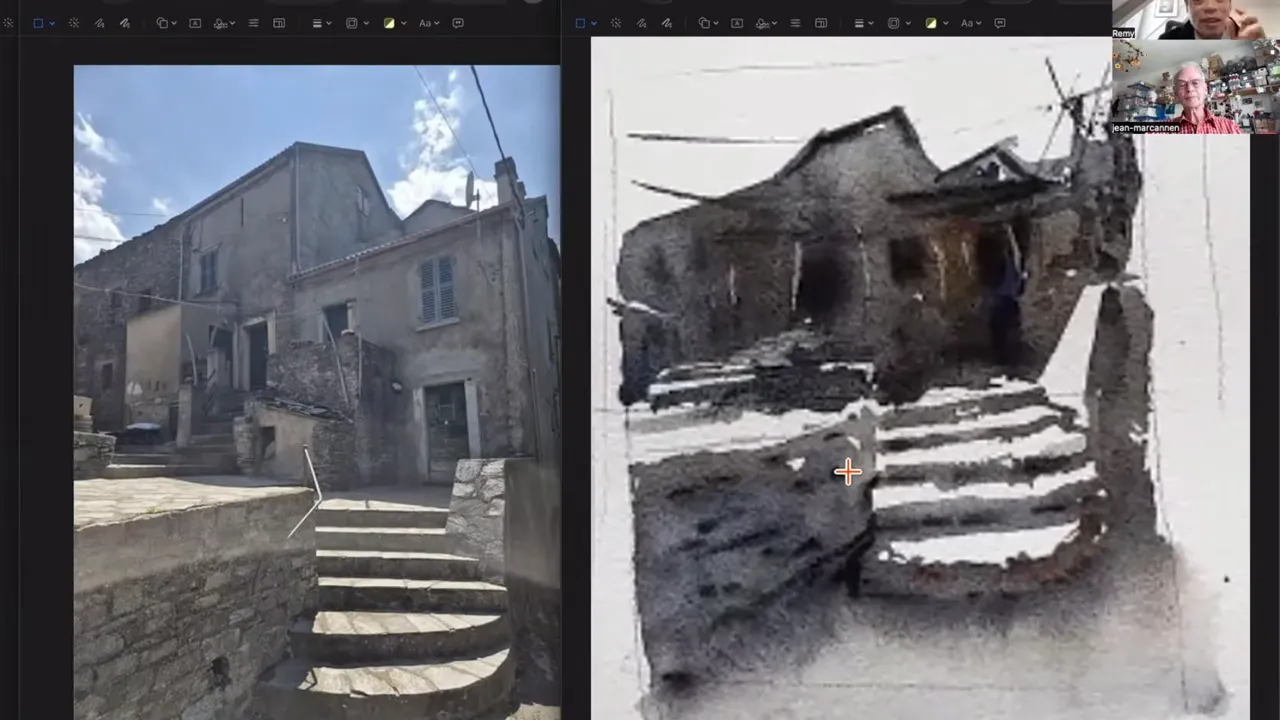
He describes his reflex himself: when he looks at a photo, his eye goes straight to the perspective. The vanishing point, the converging lines, the horizon line. On a subject with pine trees and a sidewalk coming toward us, that's all he could see. On a village house in Corsica with a sunlit staircase, the first thing he saw was how to construct the facade. Yet the heart of the painting was the staircase and its light.
How do you go from sharp to soft in a landscape?
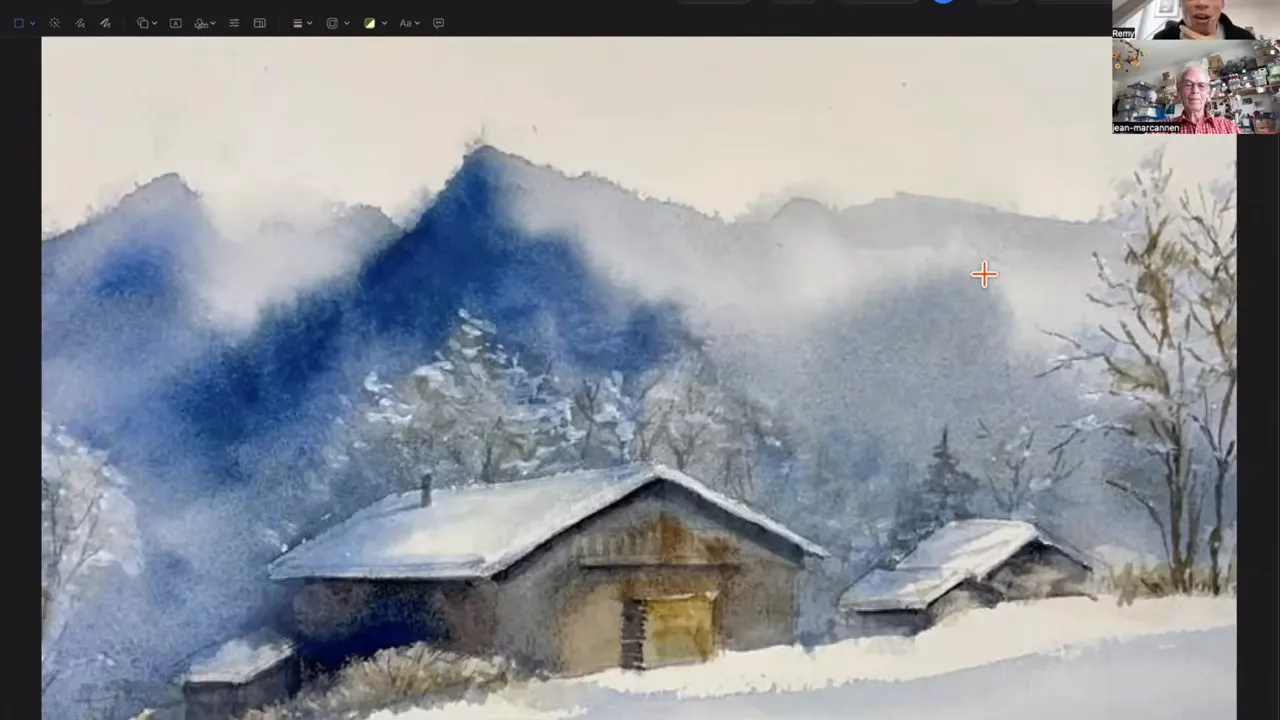
Jean-Marc already knew the basics of aerial perspective: sharp in the foreground, soft in the distance. Before, to push mountains back, he would mostly have played with color, shifting them toward blue. What he took from my approach was to work much wetter, which gives mountains that melt softly into the sky.
He applied this to a mountain chalet, completely on his own, about 1 month after joining. When I saw it come up on the forum, I thought: it's light, it's transparent, it's really beautiful, and it's truly his.
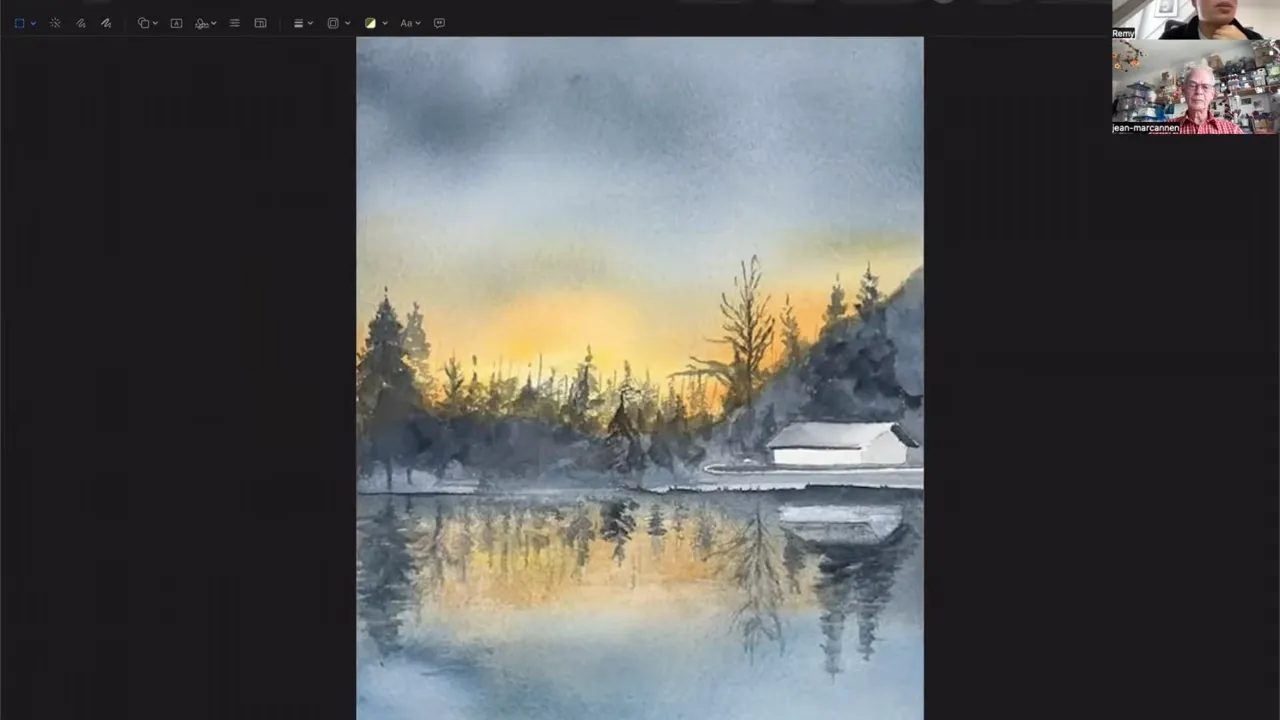
He painted the pine tree subject twice. He found the first version "dull and thin." The second one, with light coming through, made him happy. That's often what bothered him when he looked back at his old watercolors: they felt a bit flat. Bringing in that glow is a real step forward for him. And it comes from learning, little by little, to stop copying the photo and interpret it differently.
How do you free yourself from the "right" colors?
Jean-Marc took workshops with several painters who all had 2 things in common: draw what you see, and use the colors you see. He even did exercises where you invented a scene in the spirit of a photo, but matched its colors as faithfully as possible. He finds that fascinating for learning about mixing, intensity and contrast. But it's a long way from loosening up.
With me, we go somewhere else. For skies, for example, I use my primary blue, which isn't a natural sky blue. For a green, we take a turquoise and a yellow and adjust as we go: the green might be a little lighter, a little darker, maybe with a touch of blue added. As Jean-Marc puts it, "there's this approximation that does me good."
For him, loosening up happens on several levels:
- shape,
- color,
- light,
- and sometimes inventing something that isn't in the photo.
How can comparing your watercolor with others help you improve?
Jean-Marc has his own method. He likes to know the subjects a week ahead, paint them his way with what he already knows, and then watch my demo on replay. He doesn't paint along. He watches the small touches, every time I go back to the pan or the palette. My demo works as his answer key. He sees the gaps between his way and mine, and he adjusts his judgment: his fixation on perspective, for instance, maybe wasn't the main thing.
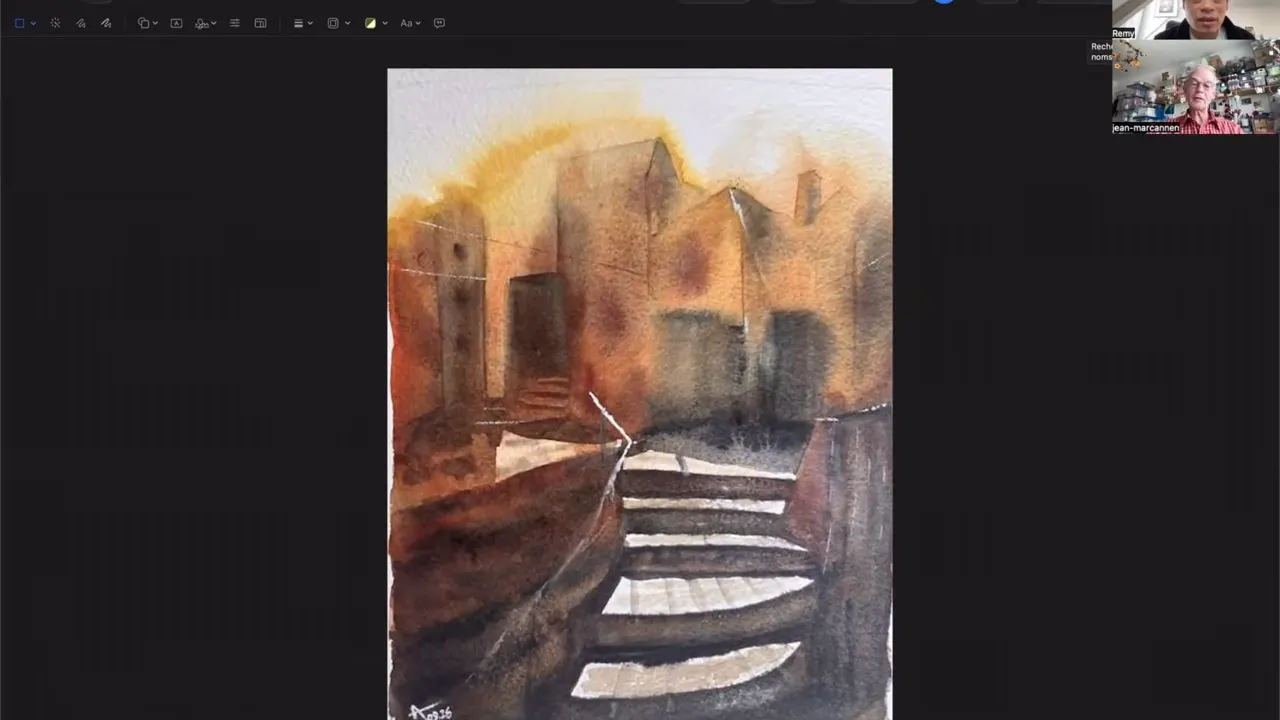
He also looks closely at what others post on the forum. With a sunset, everyone ends up with roughly the same result. With subjects like the pines, versions vary hugely from one person to the next. For the Corsican house, Antoine painted the facades in orange, yellow and pink. Jean-Marc, with his idea of nice straight facades, found it stunning. He then reworked the subject his own way: a cool facade, a warm staircase, taking on board my note about leaving the step white to keep the contrast. He isn't trying to copy. He's trying to discover other ways to handle a subject.
Do you have to give up what you know about perspective?
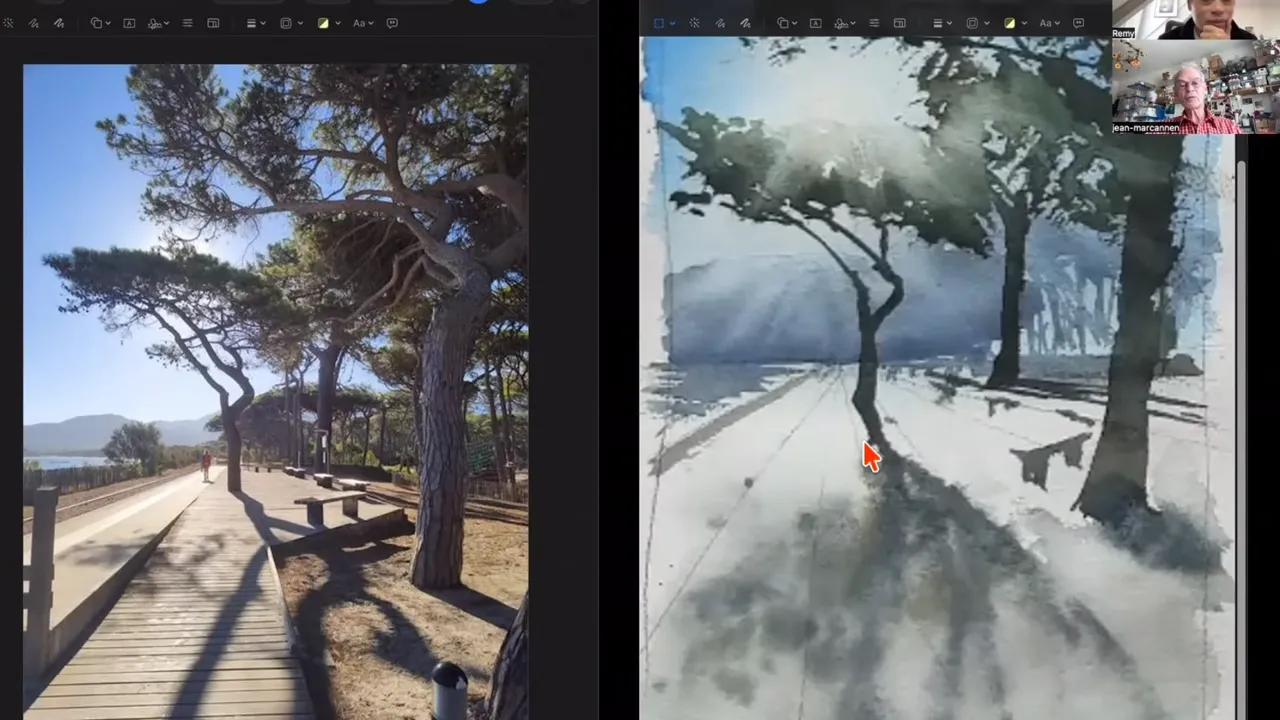
No. At first, Jean-Marc hit the roof when I explained my box technique for placing perspective landmarks without any talk of horizon lines or vanishing points. And yet, it works.
He doesn't reject what he learned, he builds on it. He accepts that geometric precision isn't essential: you can be a bit less precise and still get a lovely image, more poetic and more human than perfectly straight lines racing toward a vanishing point.
The trial-and-error side of my live sessions helped him too. I search, I sometimes mess up, sometimes I want to save a patch of light and lose it along the way. For him, that shows you can get it wrong and start again, and he finds it reassuring.
Is it too late to change the way you paint at 77?
I often hear "at 70, you can't change." Jean-Marc says it's not too late. You just need to want to change and discover something new. Often, if people don't try, it's because they think they won't manage. It might take 1 month, 6 or 12, but you can improve.
He doesn't call himself a master of loosening up yet, but he feels more flexible, with a lot more "self-permission," especially with color. What he loves about watercolor is the element of chance, the way it shows up in blends, soft edges and gentle transitions.
FAQ
Do you need to paint along with the demo?
Not necessarily. Jean-Marc prefers to watch without painting, then paint on his own afterward. He often paints the subject before the demo even happens, so he can use it as an answer key.
Is the vocabulary in my classes hard at first?
Jean-Marc felt a bit lost with the vocabulary at first. Little by little, by following the masterclasses and using the written glossary, he picked things up one at a time.
What does Jean-Marc still struggle with?
White clouds in a blue sky still give him a hard time. He uses the weeks without a new subject to keep working on them.
If you want to finally create on your own, with a proven system instead of copying tutorials, this is exactly what you'll find here 👇
Discover The Loose Watercolor System