December 2, 2025
How to deal with shame about your failed watercolors
I don't think the shame you feel about your watercolors ever really goes away. You can't make it disappear, but you can embrace it and learn to appreciate what you paint a little more, especially through other people's eyes. The day you manage to love yourself even when you feel you've failed a painting, I think you've won everything.
Does the shame go away with experience?
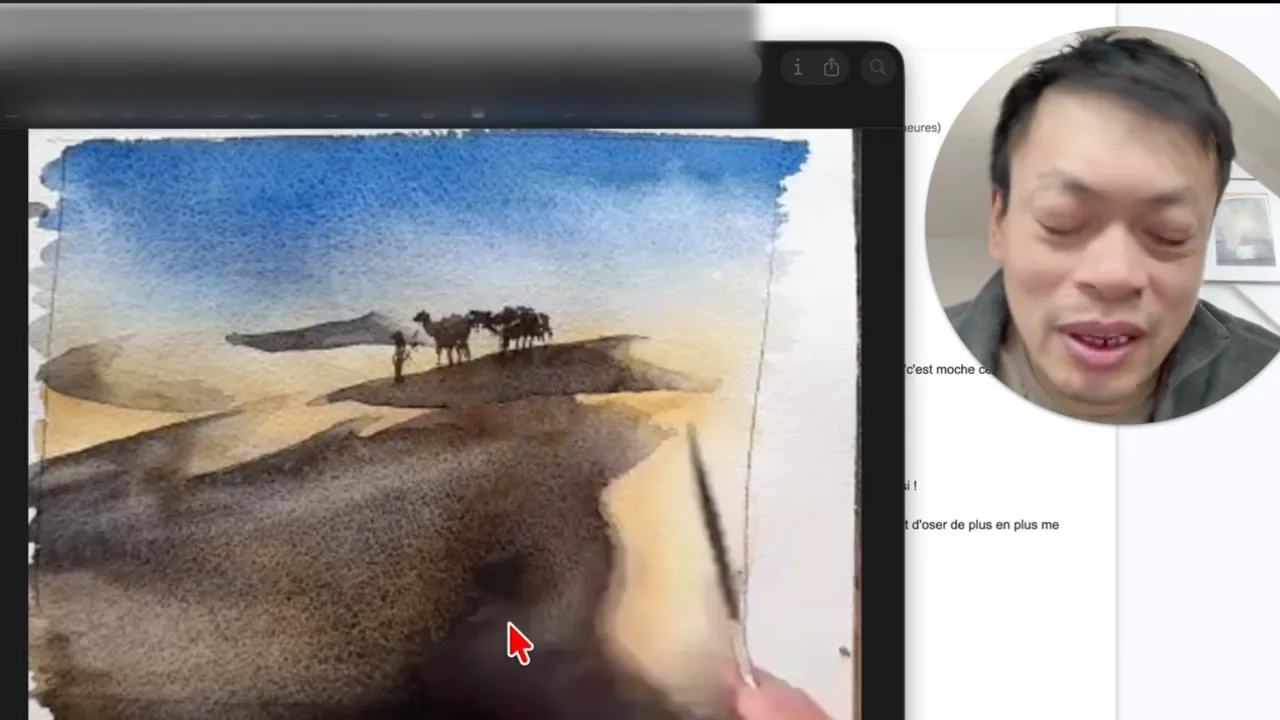
No. I can only speak from my own experience: I feel ashamed regularly, even during my live streams. The last time, I was painting a desert in Tunisia. At one point, I looked at what I was doing and thought: "This looks like nothing. I'm so embarrassed, it's ugly."
I felt I was overworking it and losing all the texture of the sand. It annoyed me. During the live stream, I kept saying "it's not great", trying to play it down, but that was an understatement: inside, I was devastated. I even wanted to cut that part, thinking: "I hope the people who see the replay skip this bit."
While I was painting, I had 10,000 thoughts running through my head:
- "That's bleeding a bit too much."
- "That's ugly."
- "It shouldn't look like that."
- "What will people think?"
That feeling of shame never goes away. What can change, though, is the way you live with it.
What should you do with a watercolor you're ashamed of?
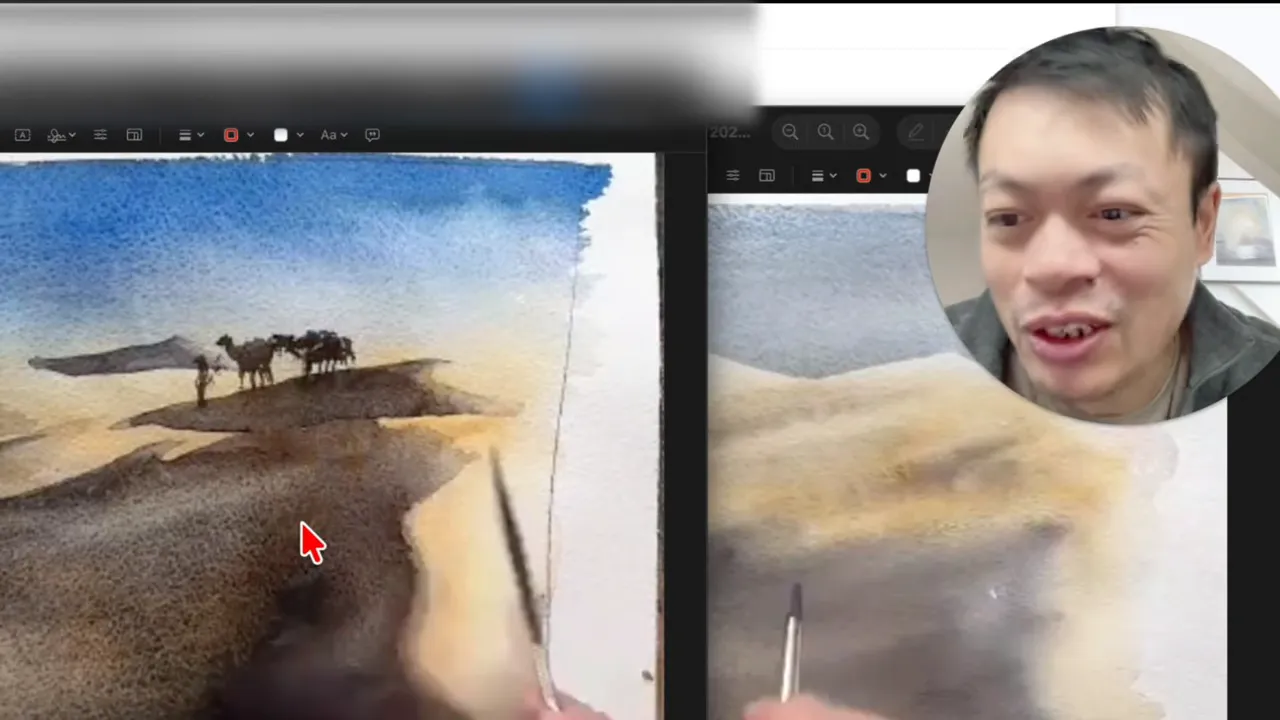
During that live stream, the shame first gave me the fuel to say: "Come on, let's try something else." Because my students weren't judging me, we had the chance to try another approach. We did a second attempt, with lighter sand. That second attempt had everything I dream of: lightness, spontaneity, letting go.
At the end, I said: "Good thing we did that, and good thing I messed up the first one." And then Xavier told me: "I actually liked that first attempt. It's good too."
I don't know if that played a part, but during the week, my sketchbook stayed out in the studio. I could see that desert from across the room, and I thought: "Oh wow, it's actually not bad." When I take out the second attempt now, I almost prefer the first version. The one I never fully finished, that I painted too fast, feeling my way through it, in full exploration mode. I've come to appreciate that watercolor more, even though at the time I hated it.
How do other people help us appreciate our watercolors?
This is where you can grow: learning to appreciate what you do a little more. And other people can help you become aware of it. Xavier's comment is one example.
After that live stream, I also told Violine that I hadn't felt up to it, but had done it anyway. She replied: "Honestly, well done." Other people help you appreciate who you really are.
There's a saying often used about presentations: you won't remember what you were told, but your body will always remember how you felt in that moment. The pleasure of painting is part of that feeling. It stays anchored in you, and that's how you find your style.
Isabelle, one of my students, wrote to me after daring to post watercolors she thought were ugly. They were anything but ugly: she had pulled off a beautiful blend of colors. She told me that my authenticity was helping her find her own way toward hers and dare to show who she is. That's the most beautiful thing there is.
It's also thanks to you, when you tell me that me being myself changes absolutely everything. I didn't wake up one day and decide on my own that it was great to fail, laugh and crack jokes.
Why shouldn't you try to love yourself all the time?
Thinking "I'll reach a point where I love myself all the time, no matter what" is, to me, a fantasy. And if you did reach that point, the risk would be ending up complacent.
Humility, self-awareness, constantly questioning yourself: that's what lets you relearn, little by little, each time, to love yourself a bit more. It never ends.
What does shame tell us about ourselves?
Whenever there's procrastination, resistance or disappointment, there's a lesson you can still learn. Watercolor hands it to you on a silver platter, because it all comes from your feelings: it means there's a part of you that you haven't fully loved yet.
For me, that live stream on YouTube was a way to love myself a little more. Part of me wants the Rémy who appears on YouTube to be perfect, a brilliant teacher who speaks clearly, explains everything well and never gets a single negative comment. And part of me doesn't like the Rémy who trips over his words, stammers and paints total flops.
For 15 years, I wore a mask: the perfect employee. After a while, your true nature always comes back. You don't really have any choice left but to be yourself.
In the end, the watercolor itself doesn't matter that much. It's only a vehicle to reach something bigger: loving yourself a little more and accepting yourself as you really are. Through a few pigments on a scrap of paper, it crystallizes a feeling. It's a mirror: it reflects back what you don't like about yourself. Every negative feeling is one of the best opportunities to evolve, learn to love yourself and grow.
How can you measure your own progress?
Here's an exercise: what do you do naturally today that you didn't do 2, 3, 4 or 5 years ago?
For me, it's laughing during my live streams. In my very first YouTube videos, I didn't allow myself to laugh. There was a part of me I hated: Rémy the clown. He had to stay in the closet, because YouTube Rémy had to be serious, prove he was legitimate and make beautiful things. Failed watercolors were not to be shown.
Little by little, I learned to embrace that part of me. Today, I'm even starting to make jokes in my emails, which I never used to do.
FAQ
Do you eventually stop feeling ashamed of your watercolors?
No, and believing otherwise is a fantasy: I still feel ashamed of some of my watercolors, even live. What improves is your ability to embrace that shame instead of running from it.
Should you keep a watercolor you're ashamed of?
Yes, because the way you see it changes with time and through other people's eyes. A watercolor you hated in the moment can, a few days later and seen from across the room, turn out better than an attempt you thought was a success.
What is shame good for when you paint?
It's a signal: it points to a part of you that you don't accept yet. Every negative feeling in front of the paper is a chance to learn to love yourself a little more.
If you want to finally create on your own, with a proven system instead of copying tutorials, this is exactly what you'll find here 👇
Discover The Loose Watercolor System