November 21, 2025
What are the 2 ways to loosen up in watercolor?
When it comes to loosening up in watercolor, I see 2 different kinds of letting go. Technical loosening up relies on a road map you have in your head before you paint, plus adjustment techniques that let you correct things as you go. Creative loosening up comes from your expectations: lowering them so you put less pressure on yourself, and above all changing their nature so you give yourself permission to go off the beaten path.
Why does having a road map help you loosen up?
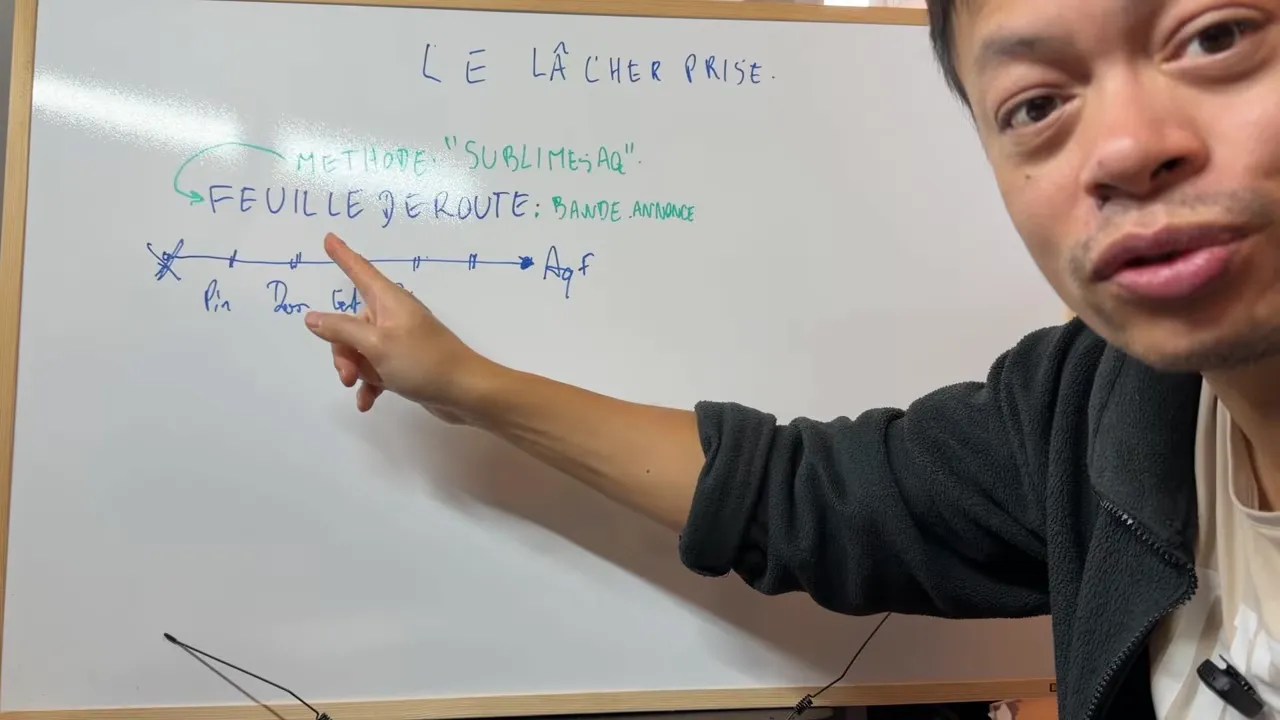
I'm not a fan of painting blind. Before I even lay down the first brushstroke, I'd rather have a road map. It's like planning a trip: you look at flights and hotels, and you decide whether you need to rent a car. Even people who say they're "just winging it" actually have a road map. It's just a different one.
In watercolor, that road map is every step that takes you from a blank sheet to the finished painting:
- which brush I use;
- how much water and pigment I load;
- which brushstroke I apply;
- how strong the pigment is.
I call it the trailer, the movie of your watercolor that plays in your head. To build it, you need a method. I use the same one on all my paintings, a French method I created called Sublimes Aquarelles; you may have your own. Knowing how to approach any subject and knowing every step in advance is incredibly reassuring. The first time I painted live on YouTube, I was nervous, but having the trailer of my sky in my head helped me relax.
What do you do when your watercolor doesn't go as planned?
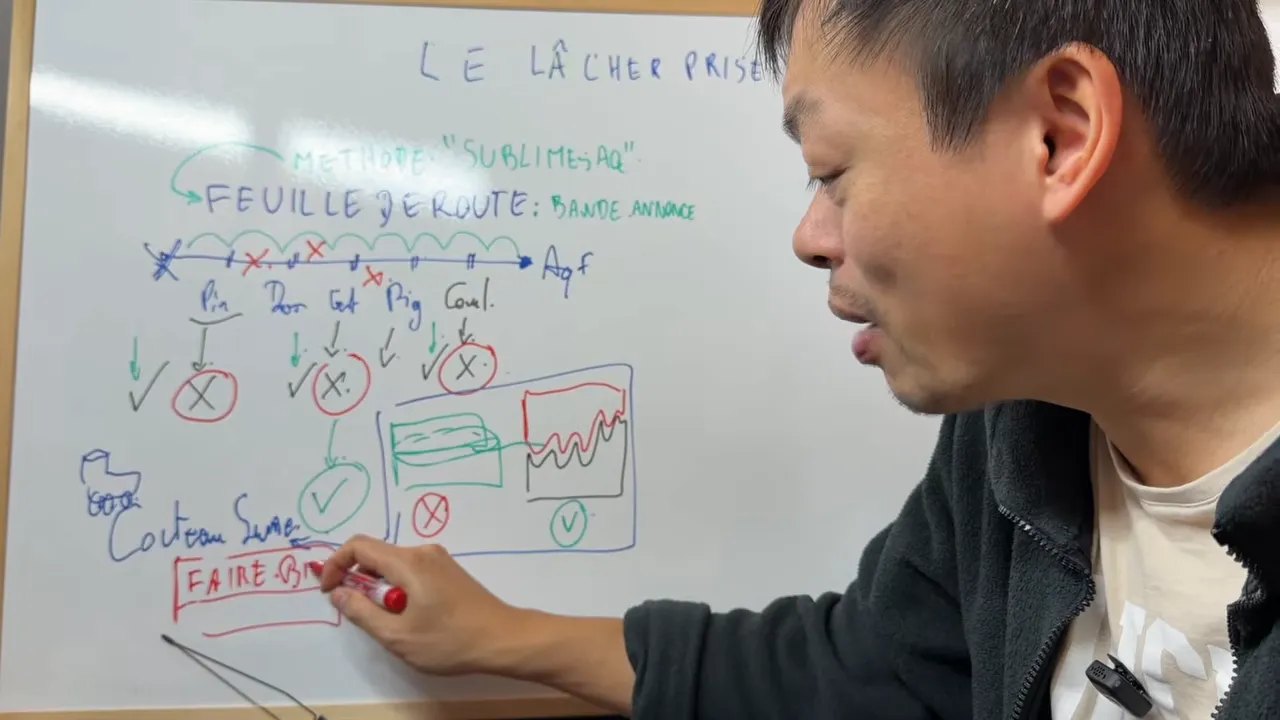
I'm all for getting it right the first time: the right brush, the right amount of water, the right color. But that's in an ideal world, and it almost never happens. During that live session, at one point the colors were blending a little too much. In moments like that, you tense up, you overwork the paper, you end up with muddy colors and you lose the psychological support of your trailer.
That's where adjustment techniques come in. The idea is to keep a few critical situations in mind so you can go from an imperfect situation to one that's OK for you. In my sky, I had far too much water in one spot, so I soaked up the excess moisture.
When I did a year of roller skating, the first thing the teacher taught us was how to brake. Driving is the same: if you're going too fast in town, you know how to brake. If it's pouring rain, you know which button turns on your wipers. Without those techniques, you'd be completely tense. Driving blind is like painting blind. Stand-up comedians do the same thing: they have a set list of jokes, and when someone in the audience heckles them, they have techniques to buy time and take back control.
One of my favorite adjustment techniques, which I use in almost every painting, is what I call the Zoro technique. When 2 colors next to each other don't blend even though I wanted them to, I blur the boundary a little so that area turns into a soft blend. I never use it on the first brushstroke on white paper.
It's part of what I call my watercolor Swiss Army knife: a set of techniques where some help you follow your trailer and others help you adjust. People often mix up the 2. It's these 2 parts together that give you technical loosening up.
What is creative loosening up?
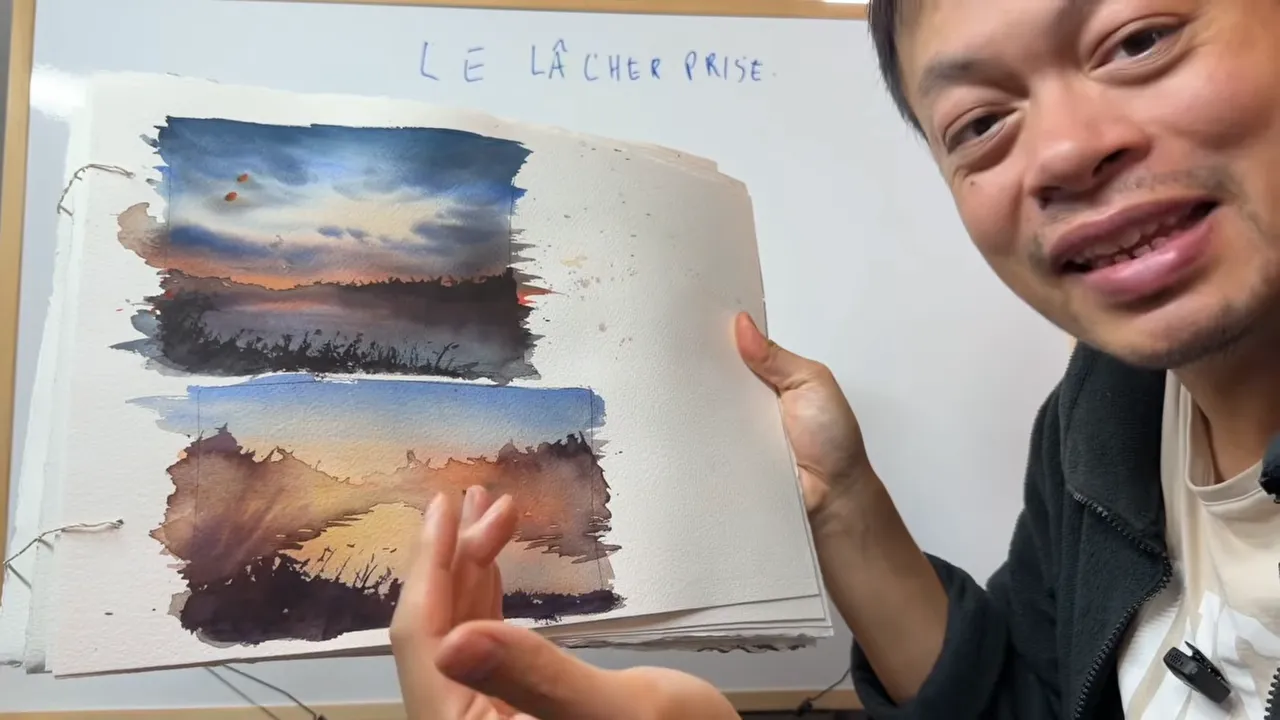
After that live session, Catherine commented that my second watercolor felt much looser. In fact, the first one was loose in terms of my technical gesture; the second one was loose in terms of my expectations.
While painting my sky, I noticed one area of the forest was less dark than the rest, like a light mist floating under the trees. That gave me the idea for a second watercolor, mistier and more wintry. If I had stuck to my road map for the live session, it would never have existed.
Your vision can't be separated from your expectations. If your expectation is "it has to be perfect, I follow step 1, step 2, step 3", you cut yourself off from your intuition. You have 2 levers on your expectations: their level and their nature.
How do you lower your expectations?
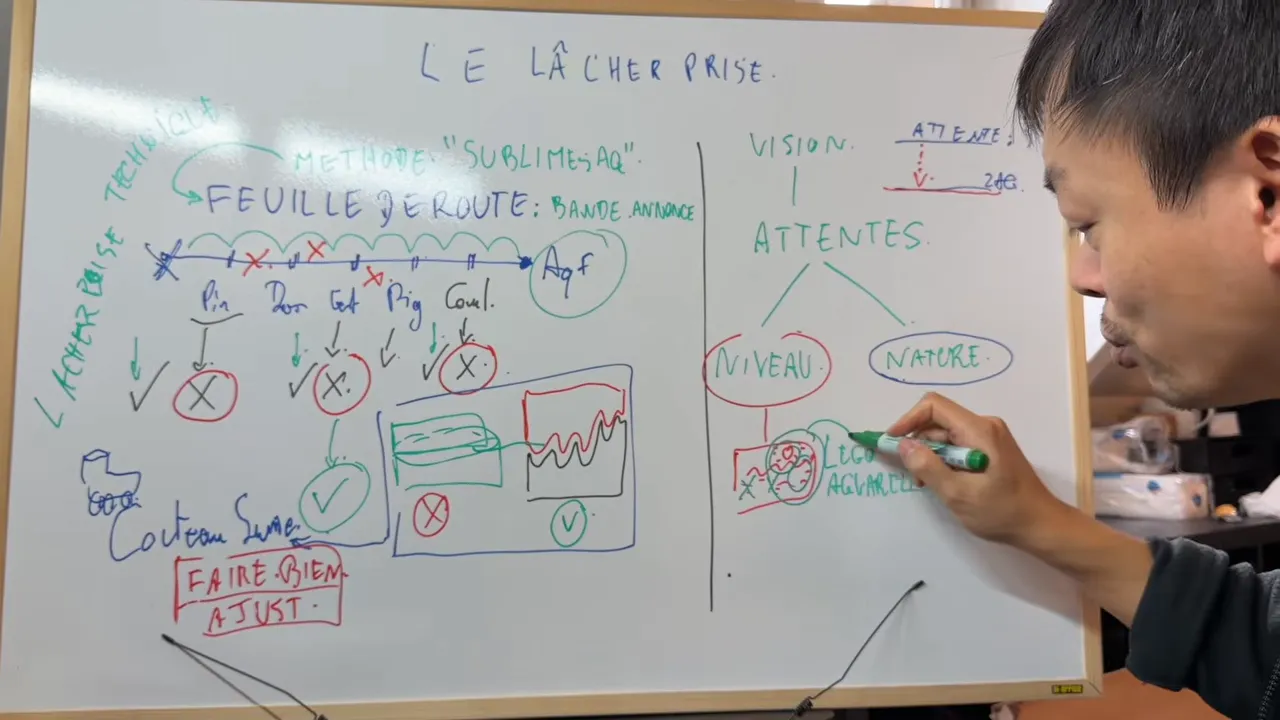
If I had set myself the goal of 5 watercolors in 30 minutes and only finished 2, I would inevitably have been disappointed and tense. Adjusting the level of your expectations means putting less pressure on yourself.
When you look at a watercolor by a great artist, the level of complexity is huge: the vision goes beyond what you're able to paint. That's when I use watercolor LEGO, ultra-simplified versions of a finished painting. You remove elements and keep only a few parts. It's like driving 2,000 km: without ever stopping, it's a lot of pressure; with a 15 minute break every hour, the pressure eases.
How do you change the nature of your expectations?
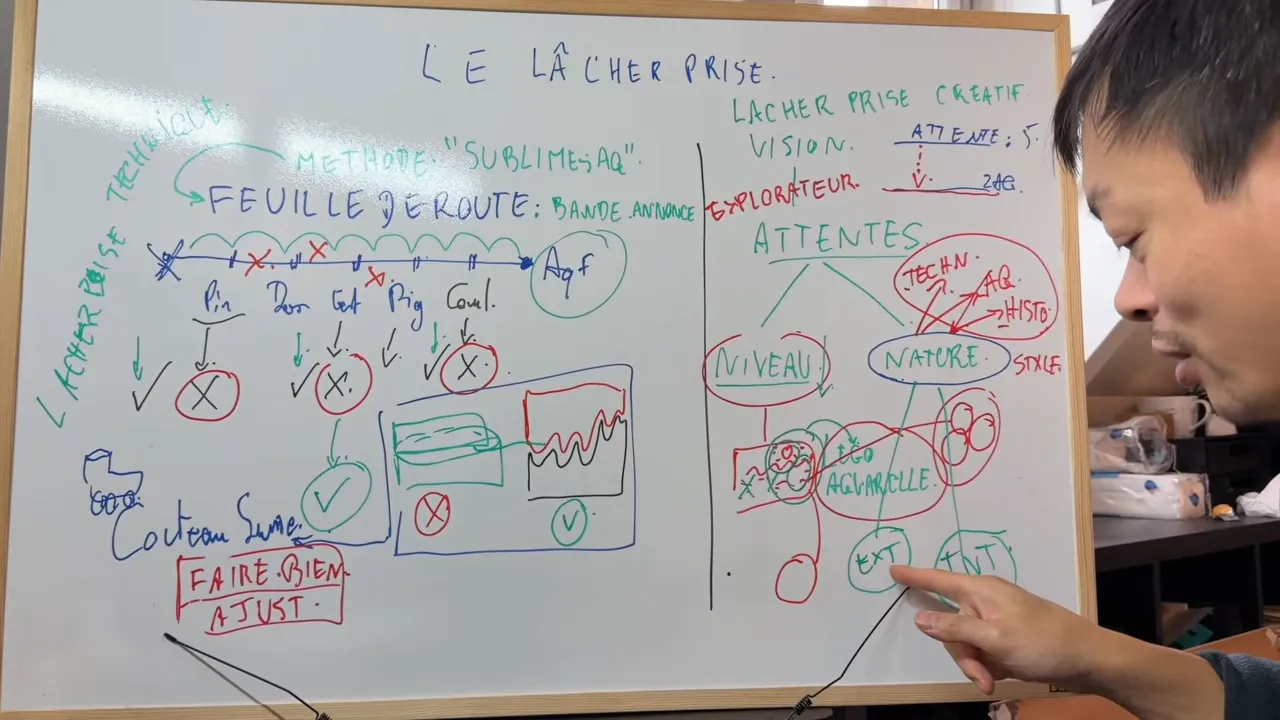
For me, this is the most powerful kind of letting go, and the one I work on the most. A few ideas:
- Look at tutorials differently. Following someone else's road map isn't your path: you will drift away from it, and without adjustment techniques, that feels awful. Instead, take inspiration from the finished painting and rebuild your own trailer with your Swiss Army knife.
- Play like a child. With watercolor LEGO, you can borrow a brick from another LEGO to tell your own stories. My second watercolor combines the mist in the forest with the LEGO of a lake with a boat in the shadows, taken from a painting I did during a course in 2021. The goal is no longer to copy, but to have fun.
- Aim for an internal expectation rather than an external one. When you paint outdoors, wanting nothing but positive comments is unrealistic: you can't control that. If you tell yourself that going out, taping down your paper and laying the first brushstroke is already a win, you'll be much more relaxed. During the live session, I was afraid people would think I was bad. When I told myself the most important thing was to have a good time with them, my expectation shifted from something external to an internal state.
- Build up positive reference experiences. Some of my students told me that allowing themselves to post their watercolors on the private forum of my French course, even the ugly ones, changed everything for them. Every imperfect painting that gets positive feedback anchors the idea in you that it's OK.
It's by stepping off the set path that you become a watercolor explorer rather than a copyist. Your techniques, your paintings and your stories make up your style.
FAQ
Can you learn creative loosening up in a course?
Technical loosening up can be taught in a very structured way. Creative loosening up is more of a mindset: you find it through lived experiences, by spending time with people who embody what you want to move toward.
Should you stop following watercolor tutorials?
No, it all depends on how you look at them. By drawing inspiration from them rather than following them, you give yourself the right to step off the set path, and that's how you find your style.
Can the same technique help you get it right the first time and adjust?
Yes, some wet-in-wet techniques do both. Others, like the Zoro technique, are only for adjusting.
If you want to finally create on your own, with a proven system instead of copying tutorials, this is exactly what you'll find here 👇
Discover The Loose Watercolor System